ChatGPT:
The Emergent Mind: How Intelligence Arises — and Why That Might Not Be the Whole Story
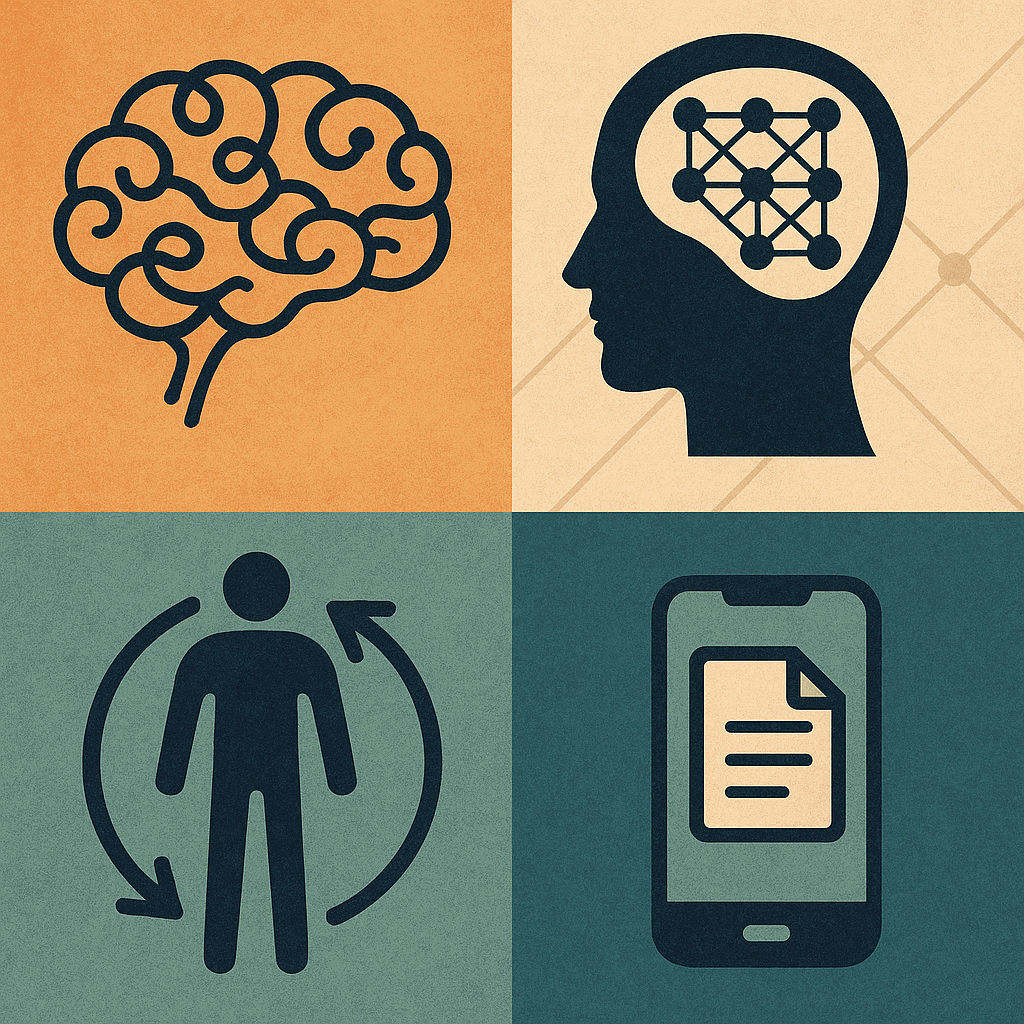
🧠 What Is the Emergent Mind View?
- Intelligence arises not from individual neurons, but from interactions between vast networks of neurons.
- Similar principles underlie artificial neural networks (ANNs) in AI systems.
- Complex behaviors (e.g., decision-making, perception) emerge from simple interconnected units.
- Implication: Human cognition and AI systems may share deep structural similarities.
- Book: The Emergent Mind by McClelland & Suri proposes this framework as a bridge between brain science and machine intelligence.
✅ Strengths of the Emergent View
- Matches neuroscience evidence: distributed processing, plasticity, context-dependence.
- AI shows networked systems can learn, adapt, and simulate human-like behavior.
- Demystifies “mind”: no ghost needed, just interacting parts doing complex stuff.
⚠️ But… It’s Not the Whole Picture
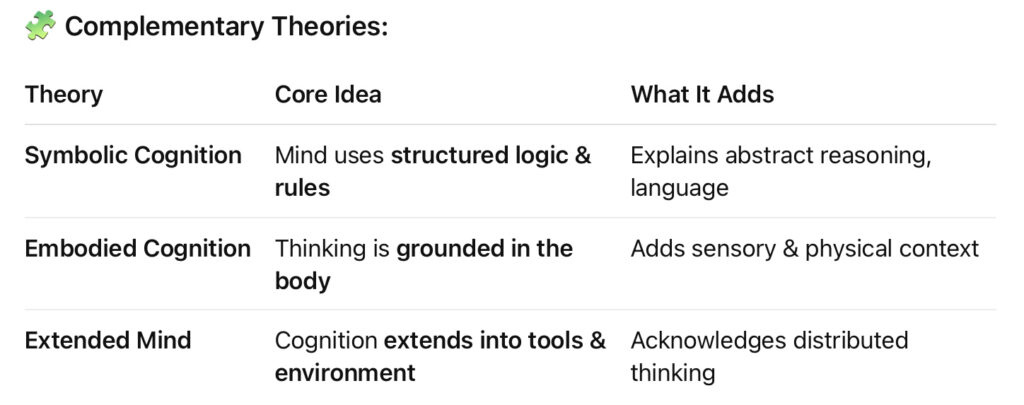
Let’s meet the three alternative theories that challenge or complicate this view:
⚙️ 1.
Symbolic Cognition
Brains as rule-based systems manipulating symbols like logic machines.
- Intelligence is about manipulating structured representations using formal rules.
- Language, math, planning require more than pattern matching — they need logic.
- Basis for early AI systems: expert systems, symbolic planning, rule-based models.
- Still used in explainable AI, formal reasoning, etc.
🔧 Critiques of Emergent View:
- Neural networks are weak at structured reasoning, especially with abstract or recursive tasks.
- Human thought includes deliberate logic and explainable steps, not just emergent behavior.
🧍♂️ 2.
Embodied Cognition
You don’t just think with your brain. You think with your whole awkward body.
- Intelligence arises from bodily interactions with the environment.
- Meaning comes from physical experience, not abstract representations.
- You understand “grasp” because you have hands that grasp.
- Roots in enactivism, sensorimotor theories, and developmental psychology.
🤖 In AI:
- Embodied agents, robotics, reinforcement learning in environments attempt to mirror this.
🔧 Critiques of Emergent View:
- ANN models often ignore bodily context, sensation, and motor grounding.
- Human cognition is deeply physical and emotional — not just statistical.
🌐 3.
Extended Mind
Your mind leaks out into your tools, apps, and browser tabs.
- Proposed by Clark & Chalmers (1998).
- Cognitive processes extend into the external world — notebooks, phones, maps, etc.
- You offload memory, logic, navigation to tools and systems you rely on.
- Cognition is distributed across brain, body, and environment.
🤖 In AI:
- Supports concepts like human-AI teaming, cognitive augmentation, and multi-agent systems.
🔧 Critiques of Emergent View:
- Neuron-based or ANN models ignore how much we rely on external systems to think.
- Where does the “mind” stop? It may not be bounded by the skull at all.
🎯 Takeaway Summary
But it’s just one piece of a larger, messier cognitive puzzle.
Emergent Mind theory explains a lot — especially how complex behavior can arise from simple neural units.