

ChatGPT:
✈️ Why Modern Supersonic Planes Might Boom Less
A Crash Course in Sonic Booms, Mach Angles, and Why the Sky Isn’t Always Screaming Anymore
🔊 First, What Even
Is
a Sonic Boom?
- A sonic boom is not just a loud sound — it’s a shockwave created when an object moves faster than the speed of sound (called Mach 1).
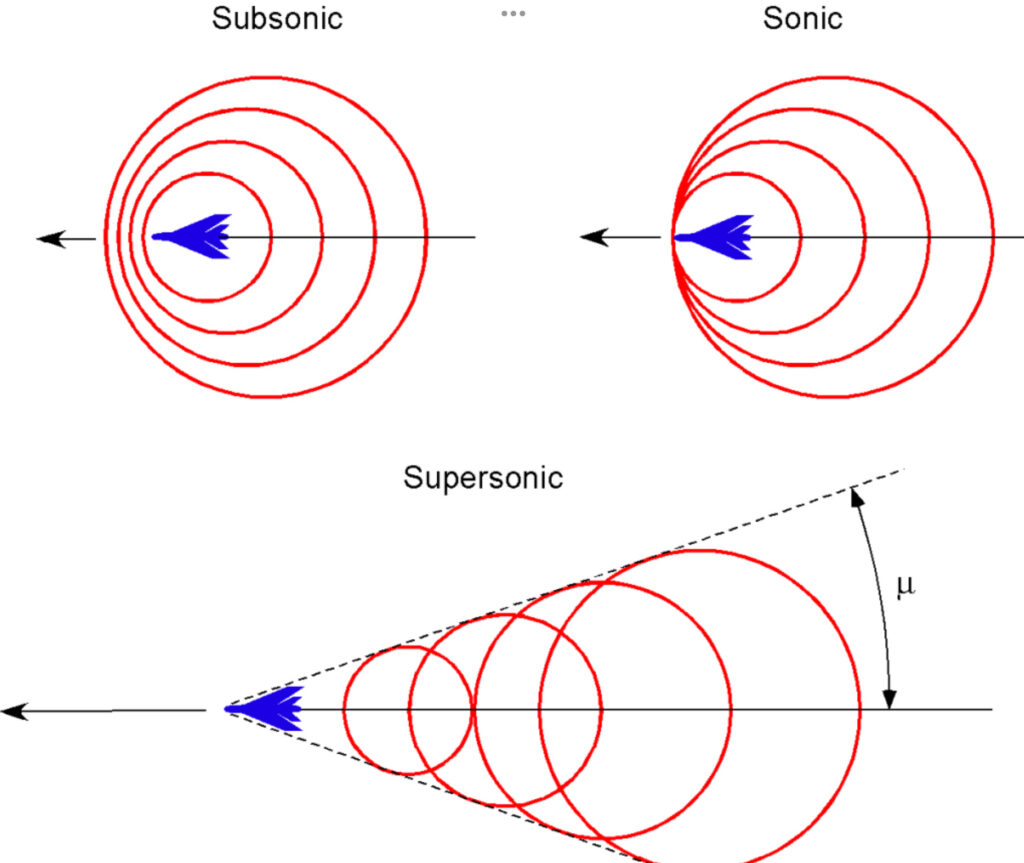
- As a plane moves supersonic, pressure waves in front of it pile up, like water around a fast-moving boat. This pileup forms a Mach cone — a V-shaped trail of compressed air.
- That cone slams into the ground as a sharp boom (or multiple booms), rattling windows, birds, and any remaining sense of peace.
🌪️ Sound Doesn’t Always Travel in a Straight Line
- In your head, sound might travel like perfect ripples in a pond. But Earth’s atmosphere is not a pond — it’s a messy soup of temperature, pressure, and chaos.
- Refraction is the key here: it’s how sound waves bend as they pass through layers of air with different temperatures or densities.
- The speed of sound is slower in cold air and faster in warm air.
- Up high? Colder air.
- Near the ground? Warmer air.
- Result? Sound bends upward because waves are always bending toward slower-speed regions.
🎯 Why This Matters for Supersonic Flight
- When a supersonic plane flies high up, and a boom is created, the shockwave travels down—but gets bent upward by the atmospheric temperature gradient.
- This means much of the boom energy misses the ground entirely.
- The higher the plane flies, the more distance and refraction work together to weaken or redirect the sound away from people below.
📐 Enter the Mach Number and Mach Angle
- The Mach number is the ratio of an object’s speed to the speed of sound.
\text{Mach Number} = \frac{\text{Object speed}}{\text{Speed of sound in that air}} - So:
- Mach 1 = speed of sound
- Mach 1.4 = 40% faster than sound
- Mach 2 = twice the speed of sound
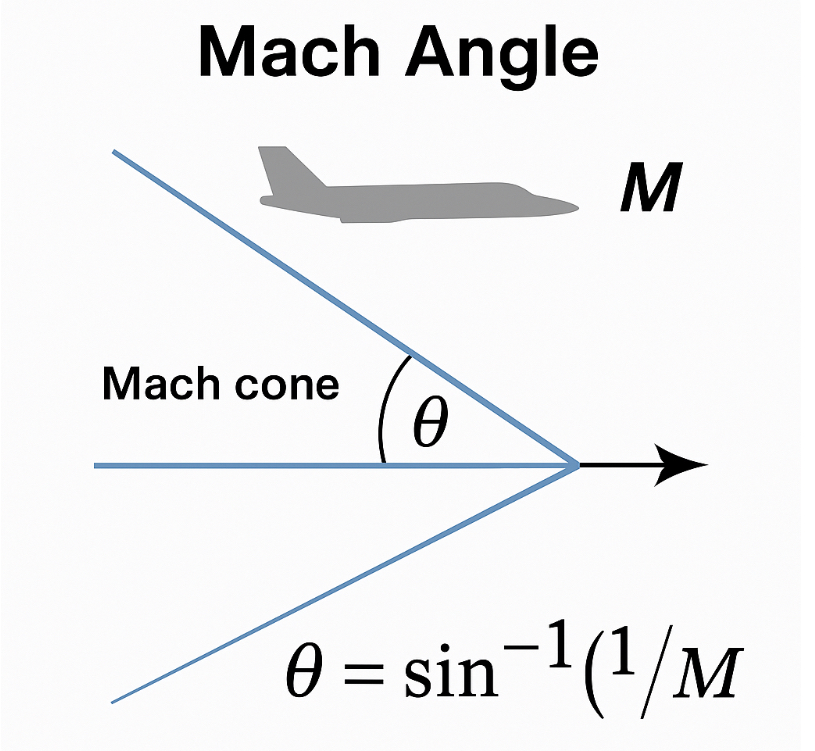
- The Mach angle is the angle between the direction of travel and the sides of the Mach cone:
\theta = \sin^{-1}\left(\frac{1}{M}\right) - Faster speeds mean smaller Mach angles, meaning a narrower cone of shockwave.
- This narrower cone can be steered upward, minimizing the area where people on the ground hear anything.
🛫 Concorde vs Modern Supersonic Aircraft
- Concorde (1969–2003) flew at Mach 2.0 at about 55,000 ft.
- Loud, blunt shockwaves.
- Created a wide boom carpet.
- Only allowed to go supersonic over the ocean to avoid irritating 1970s beachgoers with heart problems.
- Modern jets (like NASA’s X-59 and Boom Supersonic’s Overture) fly higher (~60,000+ ft) and at more optimized speeds (Mach 1.4–1.7).
- Longer, sleeker airframes shape the shockwaves to reduce peak pressure.
- Combine this with sound refraction, and you get a quieter “thump” instead of a window-shaking boom.
🌍 Atmospheric Effects Make It All More Complicated
- The real atmosphere isn’t a flat, calm gradient. It’s full of:
- Varying temperature layers
- Humidity, which can change the speed of sound
- Winds that shear and stretch shockwaves
- These factors can either:
- Help bend the sound away from the ground (yay),
- Or refocus it downward in unexpected places (oops).
- This means modern aircraft must adapt speed and altitude based on weather conditions to avoid boom zones.
🧪 Real-World Research & NASA’s X-59
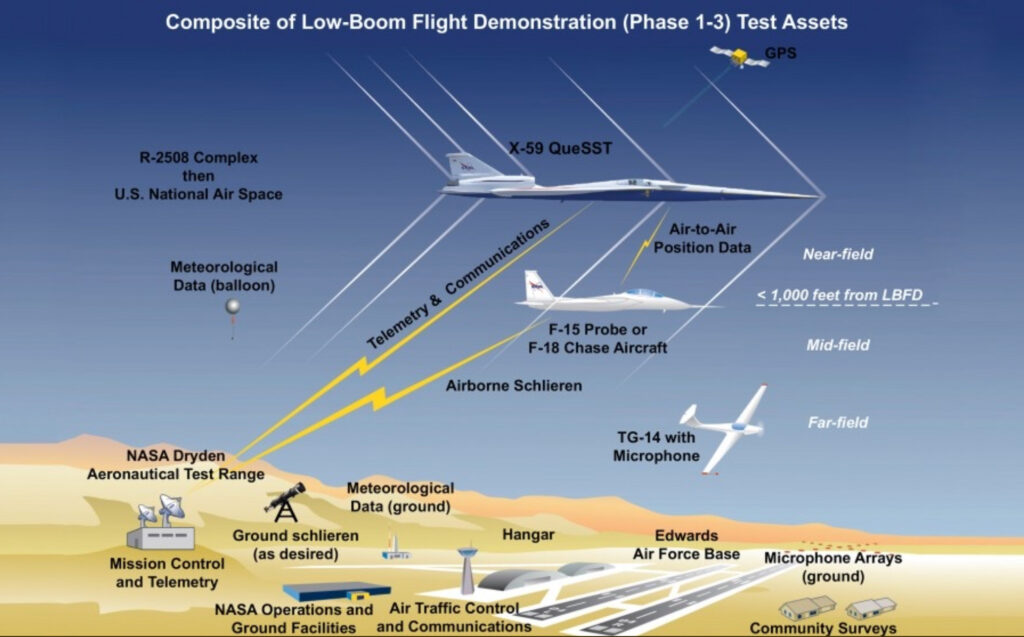
- NASA’s X-59 QueSST (Quiet Supersonic Technology) is a research aircraft designed to cruise at Mach 1.4 and about 55,000–60,000 ft.
- It’s engineered to produce a “thump” of ~75 dB PL (Perceived Level) — similar to a car door slamming — instead of a 105 dB boom like Concorde.
- The X-59’s long nose and lifted engine placement help spread and stagger the shockwaves to avoid merging into a single loud boom.
- NASA uses supercomputers to simulate “boom carpets” — showing where and how loud people on the ground might hear the shock.
- Dozens of studies show that in many flight conditions, the sound may not reach the ground at all due to refraction and altitude — a phenomenon called Mach cutoff.
🎧 How “Quiet” is Quiet Enough?
- A traditional sonic boom = 105–110 dB PL (like a thunderclap)
- X-59 target = ~75 dB PL (like a door slamming or distant rumble)
- Not silent — but less annoying, less startling, and less lawsuit-worthy
- NASA will test X-59 over U.S. communities to measure how real people respond to the “sonic thump”
🚀 TL;DR – Why You Might Not Hear the Boom Anymore
- Supersonic planes make shockwaves, but:
- Higher altitude = more distance for sound to fade
- Atmospheric refraction = bends the boom upward
- Optimized speed (Mach 1.4–1.7) = better boom control
- Modern aircraft design = shapes shockwaves into gentler pressure waves
- The result: Booms that bend away, or never reach the ground.
So next time someone says “supersonic jets are too loud for commercial use,” you can smirk like the insufferable nerd you now are, and explain that physics — and NASA — are working on it.