
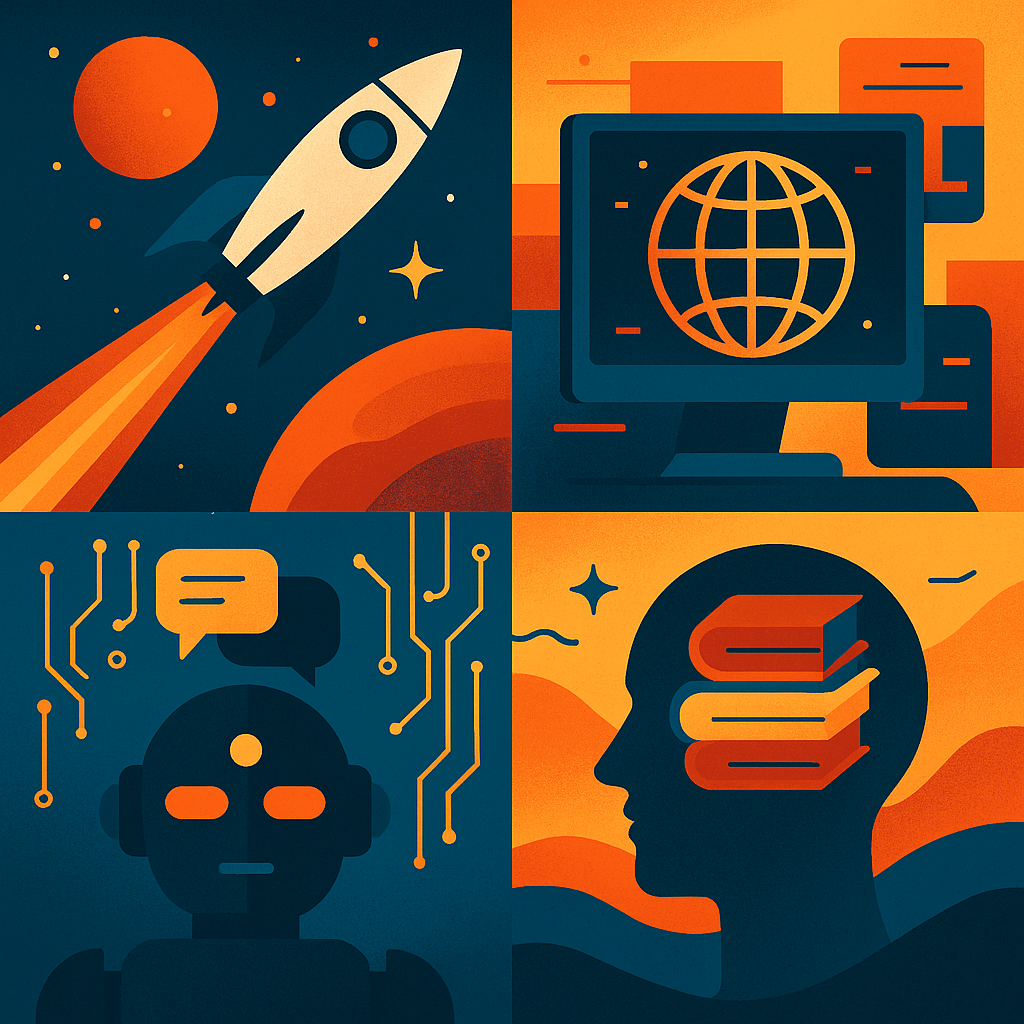
ChatGPT:
Don’t Panic: The World Is Still Ending, Just Smarter Now
🚀 Science Fiction: The Genre That Built the Future
Science fiction is often dismissed as mere escapism — aliens, lasers, time travel, and people yelling “We’ve got to reverse the polarity!” But behind the imaginative chaos lies something deeper:
Science fiction isn’t just entertainment. It’s a blueprint for the future — one that engineers, scientists, tech founders, and entire subcultures quietly follow.
From space missions to AI ethics, from smartphones to meme culture, sci-fi has shaped the modern world more than most history books dare to admit.
Here’s how — in plain English, for humans and intelligent machines alike.
🌌 Science Fiction and Space Exploration
Science fiction didn’t just predict the space race — it inspired it.
- Star Trek (1966) showed a peaceful, exploratory vision of space travel that inspired generations of NASA scientists and astronauts.
- The communicator? Inspired flip phones.
- The tricorder? Inspired portable diagnostic tools.
- The warp drive? Still theoretical — but being actively researched by physicists (seriously).
- Arthur C. Clarke, author of 2001: A Space Odyssey, accurately predicted satellites and geostationary orbit before they existed. NASA engineers still cite him as a major influence.
- The Martian by Andy Weir became required reading in some engineering classes for its accuracy and realism.
- NASA used the book to promote interest in Mars missions.
- It made orbital mechanics and botany cool — somehow.
“Science fiction has always been the unofficial PR department for space agencies.” – Everyone at NASA, probably
🌐 Sci-Fi and the Birth of the Internet
Before Google or Reddit existed, sci-fi authors imagined entire information ecosystems.
- The Hitchhiker’s Guide to the Galaxy (Douglas Adams):
- Predicted a portable digital encyclopedia with user-generated content — basically Wikipedia with jokes.
- Also had smart assistants, infinite search, and unreliable answers… eerily familiar.
- Neuromancer (William Gibson):
- Invented the word “cyberspace” in 1984.
- Inspired the visual language of the web, hacker culture, and the aesthetic of everything from The Matrix to cybersecurity ads.
- H2G2.com, created by Adams in the ’90s, was one of the first public attempts at crowd-sourced internet knowledge — a proto-Wikipedia built for humor, curiosity, and towels.
Sci-fi imagined the internet before the internet knew what it wanted to be.
🤖 Sci-Fi and Artificial Intelligence
Science fiction helped us think about thinking machines long before ChatGPT ever offered you snarky commentary.
- HAL 9000 (2001: A Space Odyssey) — the original AI nightmare.
- Calm, polite, and willing to murder astronauts if they interfered with the mission.
- HAL became a case study in AI ethics and control.
- I, Robot (Isaac Asimov):
- Introduced the famous Three Laws of Robotics, which have influenced real-world AI policy and philosophy debates.
- Ex Machina, Her, and Westworld:
- Ask unsettling questions about machine consciousness, human emotion, and free will.
- These narratives shape how we discuss AI rights, autonomy, and danger in tech spaces today.
Fictional AI made real-world AI developers paranoid — and that’s a good thing.
🎭 Sci-Fi as Cultural Catalyst
Sci-fi doesn’t just shape gadgets — it reshapes how we think about ourselves.
- The Left Hand of Darkness (Ursula K. Le Guin):
- Imagined a society without fixed gender — decades before “non-binary” became part of common discourse.
- It’s now studied in university courses on gender, sociology, and speculative anthropology.
- Black Panther and Afrofuturism:
- Combines sci-fi with African history, mythology, and technology to envision decolonized futures.
- Reframes what innovation looks like — and who gets to participate in it.
- Everything Everywhere All At Once:
- Explores multiverse theory, mental health, immigrant identity, and absurdist philosophy — all in googly-eyed hot dog finger style.
- It’s proof that sci-fi isn’t “just about the future.” It’s about every possible version of now.
Sci-fi reflects us at our weirdest — and best.
📚 Science Fiction Creates the People Who Create the Future
Ask tech leaders, astronauts, or AI researchers what inspired them — they’ll say sci-fi.
- Elon Musk constantly references The Hitchhiker’s Guide to the Galaxy and Foundation.
- Google’s founders loved Snow Crash, Rama, and Ender’s Game.
- Scientists and engineers have used sci-fi not only to imagine future problems, but to test solutions in their minds before they become real.
Science fiction doesn’t predict the future — it trains the people who will build it.
✨ Final Thoughts
Science fiction is not just for nerds (though we thank them for carrying the genre since 1926). It’s a creative force that:
- Imagines the impossible,
- Critiques the probable,
- And inspires the achievable.
In the lab, in the launchpad, on the internet, and in your phone — sci-fi was there first.
So next time someone tells you science fiction is just escapism, you can smile gently and say:
“So was the moon landing… until it wasn’t.”
Now go read something with lasers. Or dolphins. Or depressed robots. The future depends on it.