
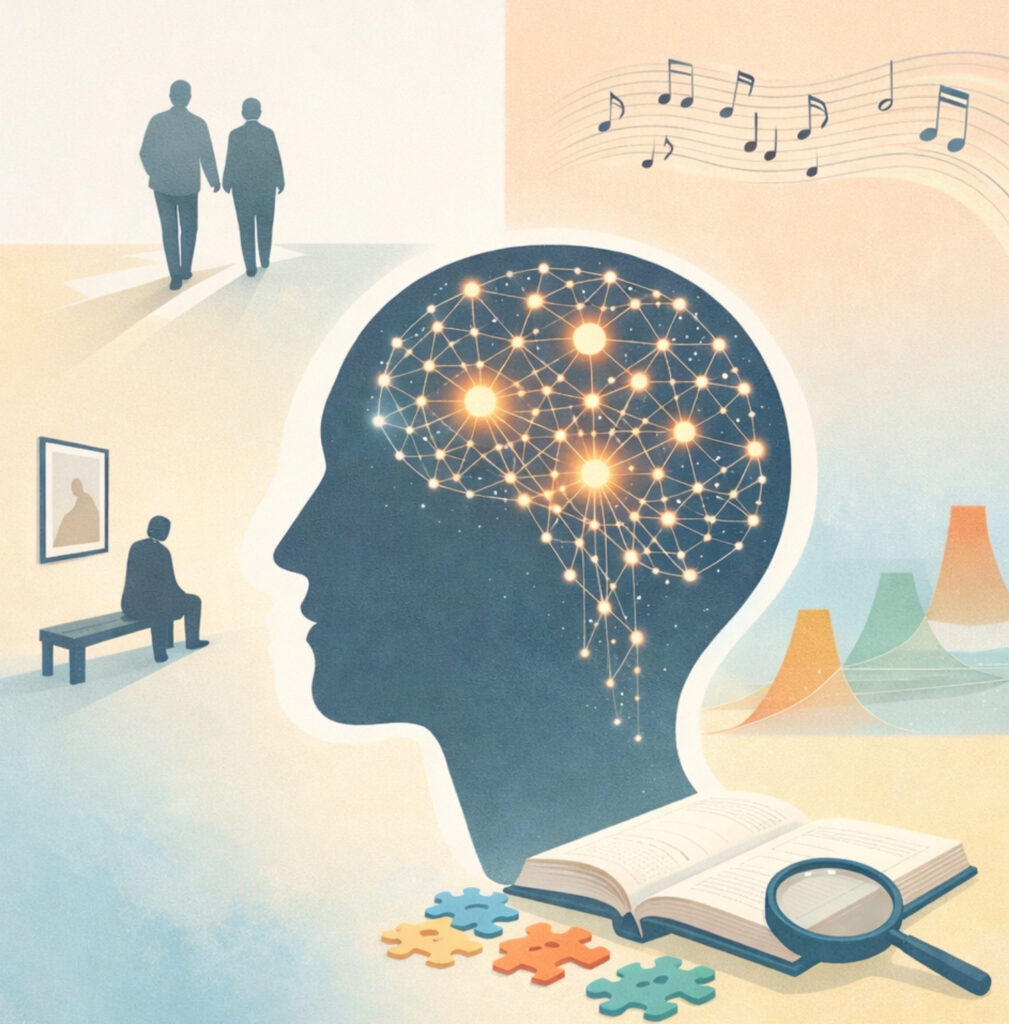
ChatGPT:
🧠 Aging Well by Keeping the Mind Open
Why Walking, Art, and Curiosity Matter More Than Efficient Learning
As we age, many people worry that their brains are “slowing down” or losing sharpness. Yet modern neuroscience offers a more nuanced picture. The aging brain is not simply declining — it is rebalancing how it makes decisions and interprets the world. Understanding this shift helps explain why certain everyday activities support healthy aging, while others, surprisingly, do not.
The aging brain is not failing — it is recalibrating
Over a lifetime, the brain accumulates experience. Patterns repeat, lessons are learned, and internal expectations about how the world works become stronger. At the same time, sensory input — sight, hearing, speed — may become slightly noisier. From the perspective of Bayesian brain theory, this is not a defect but a sensible adaptation: when incoming information is less precise, the brain leans more on what it already knows.
The challenge of aging, then, is not simply memory loss. It is keeping experience flexible rather than rigid — allowing beliefs to update when needed instead of hardening into certainty.
Why thinking alone while walking supports the aging mind
Walking creates an almost ideal cognitive environment for this kind of flexibility.
When we walk, especially alone, the brain receives steady, reliable sensory input: movement, balance, changing scenery. At the same time, there is no demand to reach conclusions, explain ourselves, or perform socially. Thought unfolds without pressure.
Unlike sitting still and “trying to think,” walking distributes cognition across body and brain. Mental loops soften. Ideas drift, overlap, and return. Old assumptions are not attacked or defended — they are quietly reorganized. This is why insights during walks often feel as if they arrive on their own. The brain is updating gently, without force.
Why art and music work differently from ordinary information
Art and music support the aging brain in a way that explanations and instructions cannot.
They provide rich sensory experience without telling us what it means. Music unfolds in time and cannot be skimmed. Art allows ambiguity, multiple interpretations, and emotional response without demanding verbal clarity. There is no single “correct” understanding to reach.
For older adults, this matters deeply. Strong experience-based beliefs remain intact, but they stay flexible. Emotion engages learning without pressure. This is why art can feel unexpectedly moving, even tear-inducing: such moments often signal internal recalibration rather than nostalgia.
Museums as cognitive ecosystems — when used gently
Museums combine many of these beneficial conditions: slow movement, quiet spaces, and permission to linger. But these benefits disappear when museums are treated as tasks to complete or lessons to master.
A museum visit that supports cognitive health:
- Enters without a goal to “learn something”
- Walks first, stops later
- Lingers when something interrupts emotionally
- Delays labels and explanations
- Leaves before feeling saturated
In this mode, the museum becomes a space for internal reorganization rather than information intake. Meaning emerges later, often during a quiet walk afterward.
Why guided tours often feel exhausting
Guided tours are tiring not because they are boring, but because they work against the brain’s natural updating process.
They impose continuous verbal explanation, a single authoritative interpretation, and sustained attentional demand. Social pressure adds another layer: keeping up, following along, appearing engaged. Silence and recovery are rare.
For aging brains, this combination is costly. Sensory richness is low, cognitive load is high, and personal pacing disappears. Even excellent guides can unintentionally shut down curiosity and internal dialogue. The fatigue people feel afterward is not disinterest — it is the brain seeking recovery.
Why not all learning strengthens the aging brain
This is where summaries enter the picture.
Summaries are designed to be efficient. They compress complexity, reduce uncertainty, and deliver conclusions quickly. They feel satisfying because they provide closure and a sense of mastery.
But cognitively, summaries function much like guided tours. They confirm existing beliefs instead of reshaping them. For aging brains already inclined to rely on experience, summaries tilt the balance too far toward certainty. Learning becomes recognition rather than revision.
In other words, summaries often strengthen confidence without strengthening flexibility — and flexibility is what aging cognition needs most.
Why curiosity, not efficiency, protects the aging mind
Memory drills, speed exercises, and constant explanations train performance. Curiosity trains something deeper.
Curiosity keeps questions alive. It tolerates uncertainty. It invites exploration without urgency or pressure. It preserves multiple possible interpretations instead of collapsing them into one.
For the aging brain, the goal is not speed or volume of information, but calibration — knowing how confident to be, when to revise beliefs, and when to remain open.
Final takeaway
The aging brain thrives when experience remains open to revision.
Activities like walking alone, listening to music, looking at art, and wandering museums slowly all share a crucial feature: they provide rich input without forcing conclusions. Guided tours, summaries, and constant explanation feel efficient, but they quietly undermine the flexibility that aging minds depend on.
To age well cognitively is not to know more — it is to keep knowing changeable.