
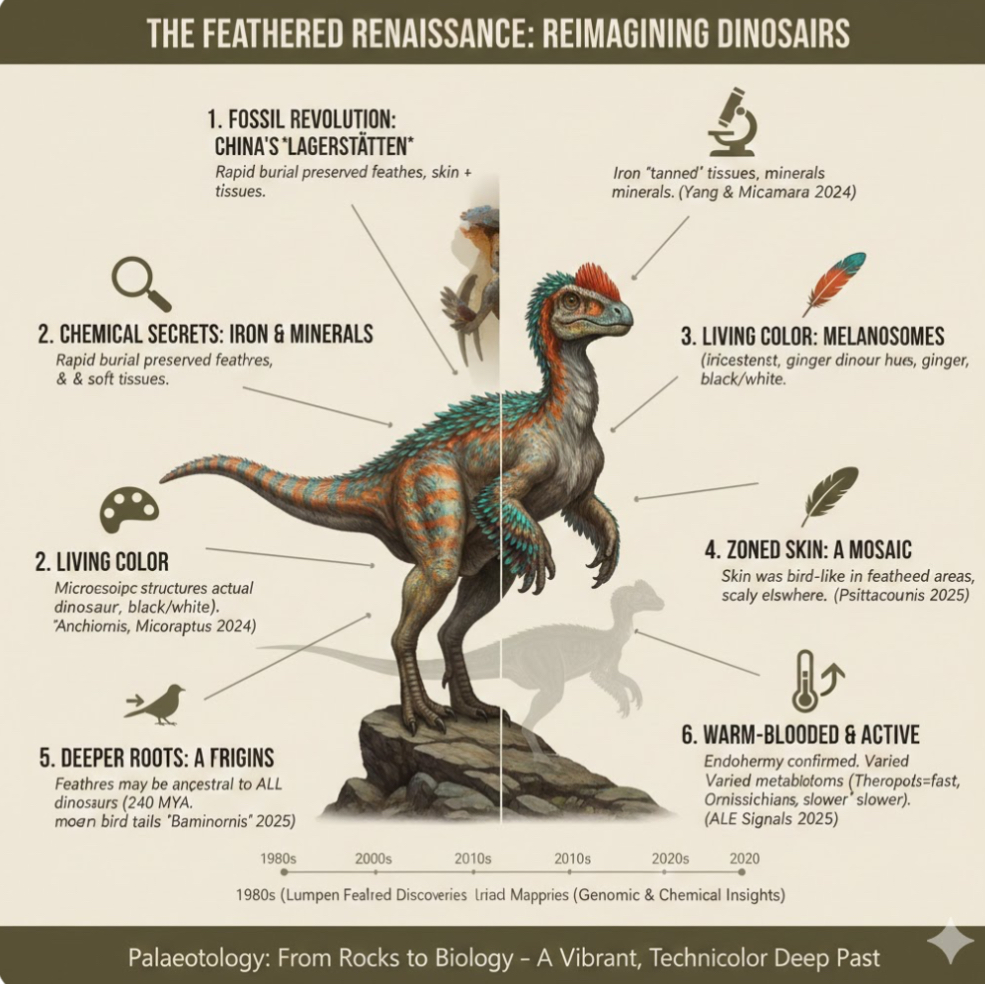
Gemini:
The Feathered Renaissance: How Palaeontology Reimagined the Deep Past
For most of the 20th century, the “dinosaur” lived in the popular imagination as a biological failure. In films and textbooks, they were depicted as “lumpen lizards”—sluggish, scaly, cold-blooded monsters that dragged their tails through primeval swamps, eventually stumbling into an evolutionary dead end. However, the last four decades have seen a scientific revolution so profound that it has effectively “resurrected” these creatures, transforming them from clumsy reptiles into the vibrant, active, and feathered ancestors of modern birds.
This transformation is not just a change in artistic style; it is a shift in our fundamental understanding of how life on Earth evolves. It is the story of how new fossils, high-tech chemistry, and a “dinosaur renaissance” rewrote the history of the world.
The Great Reveal: The Jehol Biota
The turning point began in the late 1990s, when a window into the deep past opened in northeastern China. In the province of Liaoning, volcanic eruptions 130 million years ago had acted as a “Mesozoic Pompeii,” burying entire ecosystems in fine ash and lake mud. These sites, known as the Jehol Biota, produced something the world had never seen: non-avian dinosaurs preserved with feathers.1
Sites like these are known as Lagerstätten—fossil sites with extraordinary preservation. Unlike typical fossils, where only bones remain, these specimens captured the “soft” side of life.2 We saw the “dino-fuzz” on the small predator Sinosauropteryx and the long, quill-like feathers on the arms of Velociraptors. Suddenly, the “lumpen lizard” was gone, replaced by creatures that looked more like hawks or roadrunners than crocodiles.
The Chemistry of the “Scientific Miracle”
How did delicate feathers survive for 100 million years? For a long time, it was assumed that soft tissue simply vanished over time.3 Modern palaeontology has discovered that preservation is a complex chemical trap.
When these dinosaurs were buried rapidly in oxygen-free mud, a unique process began. Iron from the animal’s own blood acted like a natural embalming fluid, “tanning” the proteins in the skin and feathers into a stable form. Meanwhile, minerals like silica or phosphate seeped into the cells, essentially “shrink-wrapping” the biological structures at a molecular level. Recent 2024 research led by Dr. Zixiao Yang and Prof. Maria McNamara even revealed that some fossils are preserved in silica—the same material as glass—allowing scientists to see individual skin cells under a microscope.4
Living Color: The Microscopic Detectives
Perhaps the most “science-fiction” development in recent years is our ability to determine the actual colors of dinosaurs. Scientists discovered that feathers contain melanosomes—tiny packets of pigment.5 Crucially, the shape of these packets dictates the color: sausage-like shapes for black, spherical ones for ginger-red, and flat, platelet-like shapes for iridescence.
By mapping these shapes across fossils like Anchiornis, researchers have reconstructed them with “mohawk” crests and spangled wings. We now know that dinosaur color wasn’t just for camouflage; it was used for social signaling, sexual display, and perhaps even temperature regulation. This has shifted the study of dinosaurs from geology (looking at rocks) to biology (looking at living systems).
The Latest Frontier: Zoned Skin and the Triassic Mystery
As we move into 2025, the pace of discovery has only accelerated. We are now realizing that the transition from a scaly reptile to a feathered bird was far “messier” than we thought.
Research published in 2024 identified “zoned development” in dinosaur skin.6 A study of Psittacosaurusshowed that these animals had “bird-like” skin only where they had feathers, while the rest of their body remained scaly like a modern crocodile.7 This suggests that the evolutionary “kit” for becoming a bird was assembled piece-by-piece, with different parts of the body evolving at different rates.8
Furthermore, the timeline is being pushed back. In early 2025, the discovery of Baminornis zhenghensis in China revealed a bird with a modern, short tail (a pygostyle) living 150 million years ago—nearly 20 million years earlier than previously recorded.9 Even more startling is the Triassic Origin Hypothesis. 2025 studies on Triassic reptiles like Mirasaura suggest that feather-like structures might have evolved 240 million years ago, long before the first “true” dinosaurs even appeared.
A New Vision of the Past
Today, palaeontology is a high-tech discipline. We use particle accelerators (synchrotrons) to detect “ghosts” of pigments and CT scans to reconstruct dinosaur brains. We have learned that the “great extinction” 66 million years ago wasn’t the end of the story—one branch of the dinosaur family tree simply took to the skies.
When you look at a sparrow in your garden, you aren’t looking at a “distant relative” of a dinosaur; you are looking at a living dinosaur. In the last forty years, we have stopped seeing dinosaurs as symbols of failure and started seeing them for what they truly were: one of the most successful, colorful, and resilient experiments in the history of life.
The journey to “see” the colors of the past has been one of the most exciting sagas in modern science. Below is a timeline of the most significant breakthroughs that allowed palaeontologists to move from monochromatic bones to a vibrant, technicolor Mesozoic.
Timeline: The “Color-Mapping” Revolution
2010: The “Big Bang” of Paleo-color
Two landmark papers published within weeks of each other changed everything.
• The Subject: Sinosauropteryx.
• The Discovery: Researchers identified spherical melanosomes in the tail feathers, proving it had ginger-colored stripes and a reddish-brown body.
• The Subject: Anchiornis.
• The Discovery: This was the first dinosaur to have its entire body color-mapped. It revealed a grey body, white-and-black spangled wings, and a striking red crown.
2012: The Discovery of Iridescence
• The Subject: Microraptor.
• The Discovery: By finding long, flat, platelet-shaped melanosomes, scientists realized this four-winged predator didn’t just have black feathers—it had a glossy, iridescent sheen, much like a modern crow or grackle. This suggested it was likely active during the day, as iridescence is a visual signal used in sunlight.
2016: Decoding Camouflage Strategies
• The Subject: Psittacosaurus.
• The Discovery: Instead of feathers, scientists studied the skin of this “parrot-lizard.” They found countershading—dark on the back and light on the belly.
• The Significance: By building a 3D model and testing it under different lighting, they proved this specific pattern was a form of forest camouflage, helping the animal disappear into the shadows of a leafy canopy.
2018: The Rainbow Dinosaur
• The Subject: Caihong juji (Mandarin for “Rainbow with a Big Crest”).
• The Discovery: This Jurassic dinosaur possessed specialized melanosomes in its neck feathers that are identical to those in modern hummingbirds. It is the earliest evidence of a “rainbow” iridescent display used for attracting mates.
2024: The “Zoned Skin” Revelation
• The Subject: High-resolution analysis of Psittacosaurus skin.
• The Discovery: This study showed that color and texture were “zoned.” The animal had bird-like skin(thin and flexible) in feathered areas to support movement, but reptile-like scales (thick and pigmented) in others.
• The Significance: It proved that the transition from scales to feathers involved a complete microscopic redesign of the skin itself, not just the appearance of fluff.
2025: The Jurassic Modern-Tail
• The Subject: Baminornis zhenghensis.
• The Discovery: While not just about color, this discovery pushed back the appearance of a modern-style tail (the pygostyle) to 150 million years ago.
• The Significance: It suggests that the “canvas” for color displays—the fan-shaped tail we see in peacocks or turkeys—was already functionally available to dinosaurs in the Jurassic, much earlier than once thought.
Summary of Pigment Discovery
Year Dinosaur Primary Color/Pattern Significance
2010 Sinosauropteryx Ginger stripes First proof of color.
2010 Anchiornis Black, White, Red First full-body map.
2012 Microraptor Iridescent Black First proof of “shiny” feathers.
2018 Caihong Rainbow Iridescence Earliest hummingbird-like display.
2024 Psittacosaurus Countershaded Proved forest-dwelling behavior.