
ChatGPT:
🌞 Stations of the Sun: A Revealing Journey Through Britain’s Festive Calendar
What if the customs we consider timeless—those comforting seasonal traditions that mark Christmas, Easter, Halloween, or May Day—were far more modern than we think? In Stations of the Sun: A History of the Ritual Year in Britain, historian Ronald Hutton offers a fascinating deep-dive into the ritual calendar of the British Isles, unearthing the complex origins, reinventions, and surprising truths behind the country’s beloved festivals.
Published in 1996, Stations of the Sun is widely considered the most comprehensive and rigorous history of British seasonal celebrations ever written. Hutton, a professor at the University of Bristol, meticulously traces how British holidays evolved through time, dismantling myths about their supposed pagan roots and revealing how Christian traditions, local customs, and modern reinventions shaped today’s calendar.
⸻
📅 A Year in Celebration
Hutton organizes the book around the seasonal cycle, beginning with winter and moving through spring, summer, and autumn. Each chapter focuses on festivals and holidays within a particular time period, from Christmas and New Year to May Day, Midsummer, Harvest Festivals, and Halloween.
He examines each tradition’s documented history, from earliest records through the medieval and early modern periods, up to contemporary practice. What emerges is a picture of British ritual life that is far from static. These traditions didn’t survive unchanged from the ancient past. Instead, they were constantly reshaped—sometimes fading away, sometimes revived, often reimagined entirely.
This view is both refreshing and surprising. Where many popular accounts tend to overemphasize continuity—suggesting that British festivals are direct descendants of ancient Celtic or Germanic pagan rites—Hutton shows that the real story is more historically nuanced and evidence-based.
⸻
🔍 The Myth of the “Pagan Survival”
One of Hutton’s major contributions is his debunking of the “pagan survival” narrative. For much of the 20th century, many believed that customs like Maypole dancing, Halloween, or Yule were uninterrupted pagan traditions that had merely been adapted by Christianity. Hutton argues that this is a romantic fiction, largely a product of Victorian folklore scholars and 20th-century occult thinkers.
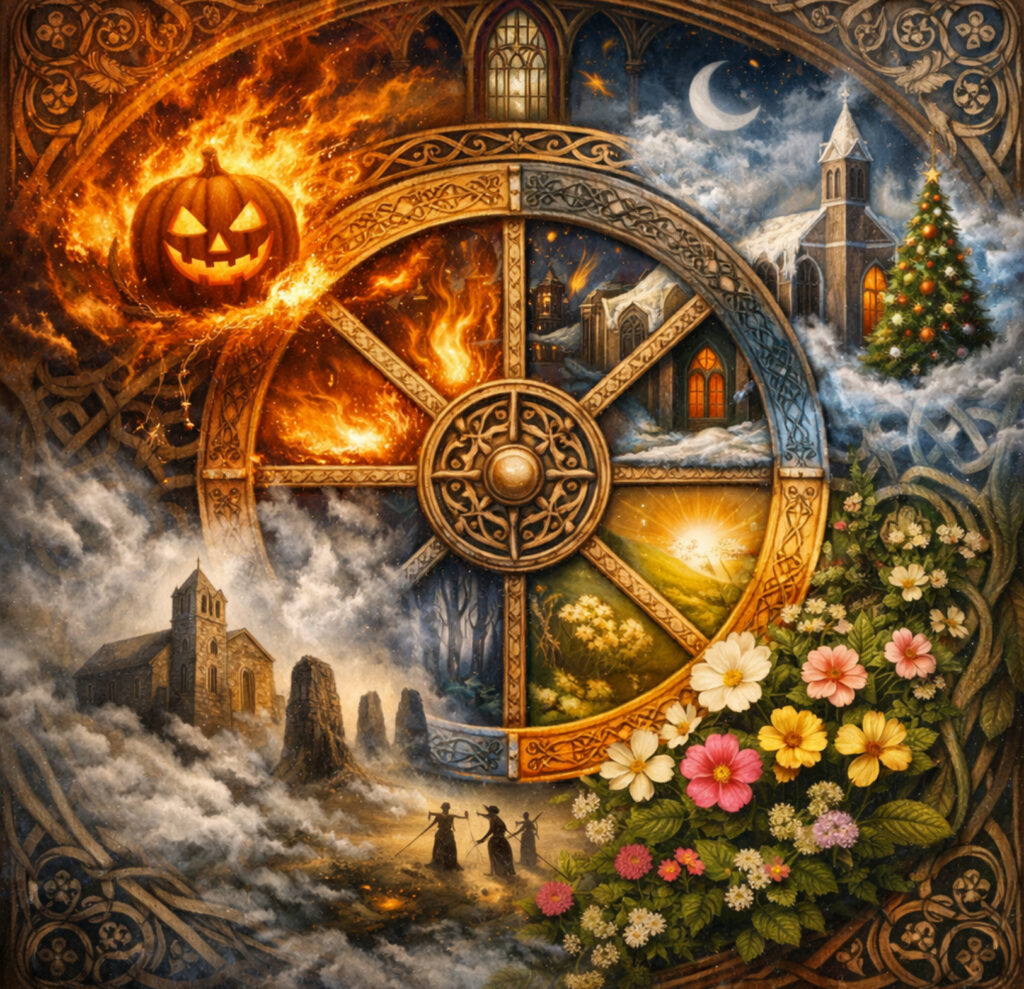
For example, the widely accepted “Wheel of the Year,” with its eight evenly spaced pagan festivals (Imbolc, Beltane, Lughnasadh, Samhain, etc.), has no historical evidence in ancient British practice. Rather, it was a modern invention crafted by 20th-century Wiccan leaders such as Gerald Gardner and Ross Nichols.
Instead of unbroken traditions, Hutton finds layered histories. Take Halloween: in England, it wasn’t widely celebrated until the late 20th century, when it was imported back from the United States, having originally traveled there with Scottish and Irish immigrants. Its link to ancient Celtic Samhain is tenuous at best, especially in England.
⸻
🎄 Victorian Invention and Modern Mythmaking
Some of the most cherished traditions, especially around Christmas, turn out to be surprisingly recent. The idea of the Christmas tree, gift-giving, and a jolly Santa Claus figure emerged during the Victorian era, influenced by German customs, Charles Dickens’s romanticized Christmas tales, and a growing culture of consumerism.
Even Bonfire Night, often framed as a vestige of fire festivals, is actually a Protestant celebration commemorating the failure of the 1605 Gunpowder Plot. For centuries, it served as an annual ritual of anti-Catholic sentiment, complete with official sermons and government funding.
Likewise, Candlemas, often assumed to be a repurposed pagan festival of light, is actually a Christian feast day tied to the presentation of Jesus at the Temple and the purification of the Virgin Mary.
These findings don’t make the festivals less meaningful. On the contrary, they show how celebrations are living traditions, shaped by changing beliefs, political shifts, and cultural creativity.
⸻
🌿 Local Variations and Christian Frameworks
Hutton also highlights the diversity of local traditions across the British Isles. Rather than a single unified ritual calendar, different regions had different customs, sometimes tied to agricultural cycles, saint days, or even local superstitions.
While pagan roots are often overstated, the influence of Christianity is deep and undeniable. Many folk customs grew directly out of liturgical calendars, church festivals, and ecclesiastical mandates. The Harvest Festival, for instance, was institutionalized by the Anglican Church in the 1840s—not a remnant of ancient fertility rites.
Similarly, Morris dancing, often claimed as a pagan folk survival, first appeared in late medieval court records as a form of elite entertainment. It only became associated with rural tradition later, during a wave of romantic nationalism and cultural revival in the 19th century.
⸻
🕰 Tradition as Invention
The most compelling takeaway from Stations of the Sun is that tradition itself is a form of historical invention. Customs are not frozen artifacts from a distant past but are constantly reinterpreted to suit the present. Whether through political need, religious reform, or cultural nostalgia, rituals evolve—and that’s what makes them powerful.
Understanding that today’s calendar is not ancient but a product of centuries of change allows us to appreciate festivals not just for their perceived antiquity, but for their flexibility, relevance, and human creativity.
⸻
🔚 Conclusion: Reclaiming the Rhythm of the Year
Ronald Hutton’s Stations of the Sun offers a captivating and meticulously researched window into how Britons have celebrated time itself. Rather than confirming comforting myths of ancient continuity, it reveals something far richer: a calendar of human resilience, adaptation, and imagination.
So the next time you hang up a stocking, dance around a maypole, or carve a pumpkin, remember: these acts are not just echoes of the past. They are also statements about the present, about who we are and how we choose to remember, reinvent, and rejoice through the seasons.