
ChatGPT:
Project Hail Mary: An Interstellar Philosophy Lesson Disguised as a Sci-Fi Buddy Comedy
Introduction: The Existential Launch Pad
Andy Weir’s Project Hail Mary is what happens when you mix astrophysics, comedy, and cosmic-scale ethics into a blender and hit maximum velocity. It’s not just a sci-fi novel—it’s a 500-page thought experiment about loneliness, sacrifice, and the great miracle of finding a friend who doesn’t have a mouth but still tells better jokes than most people you know.
Once again, Weir drops an ordinary man into an extraordinary catastrophe, because that’s apparently his love language. This time, the stakes are slightly higher than being stranded on Mars: the Sun is dying, and by extension, so is literally everything else. Earth is in a tight spot. The solution? Build a spaceship, throw one nerd at the stars, and hope for the best.
The Cosmic Fiasco: When the Sun Catches a Cold
The universe, as always, doesn’t care about your feelings. A microscopic menace known as Astrophage is happily slurping solar energy like it’s bottomless brunch. As the Sun dims, Earth faces the kind of global cooling that makes Ice Ages look like mild inconvenience.
Enter Tau Ceti, a star suspiciously unaffected by this cosmic parasite. Humanity, being both desperate and overly optimistic, decides to send a crew to figure out why. Spoiler: only one of them makes it.
Ryland Grace: The Accidental Astronaut and Professional Self-Sacrifice Machine
Ryland Grace wakes up on the spaceship Hail Mary with two dead roommates, no memory, and a vague sense that someone really should’ve proofread the mission brief. Once a middle-school science teacher (yes, really), Grace is now the entire staff of Earth’s last hope.
Over time—and because the plot demands it—his memory returns, and he pieces together the horrifying truth: he volunteered for a suicide mission, died slightly less quickly than everyone else, and now has to figure out how to save Earth with a lab kit, some duct tape, and a truly unsettling amount of spreadsheets.
Enter Rocky: Spider-Crab Engineer of the Void
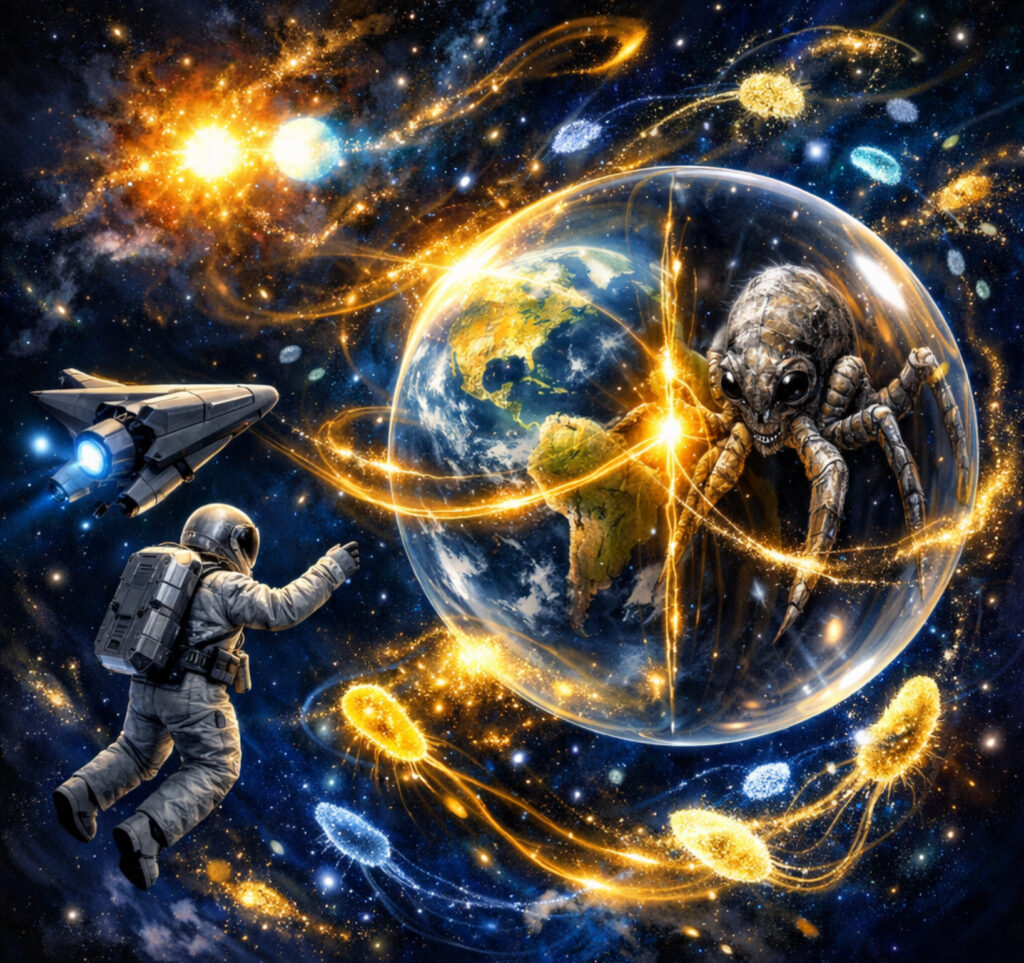
Then—plot twist—Grace meets Rocky, a spider-like alien engineer from the planet Erid. Rocky’s sun is also being slowly consumed by Astrophage, because apparently the parasite is both interstellar and annoyingly consistent.
Rocky doesn’t speak, per se—he plays music with his throat pipes like a sentient xylophone. Grace learns to communicate with him because, as it turns out, friendship is stronger than biology, chemistry, or the complete lack of shared oxygen.
What follows is a cross-species bromance for the ages. They’re like Holmes and Watson, if Watson was a six-legged alien mechanic and Holmes made dad jokes about mitochondria.
Science Wins Again (But With Slime)
Through obsessive experimentation and several brush-ups with space death, Grace and Rocky discover Taumoeba, a microbe that finds Astrophage delicious and, miraculously, doesn’t eat literally everything else. It’s nature’s tiny, wriggly “undo” button.
Grace quickly realizes that Taumoeba could be the solution both Earth and Erid need. Cue triumphant montage music and moral quandaries.
Moral Crossroads and One-Way Tickets
After preparing four tiny probe ships (named after the Beatles, because Grace is a man of culture and also has limited bandwidth), he sends them back to Earth carrying the salvation slime. Mission complete. Champagne corks pop in spirit.
But disaster never takes a vacation: Rocky’s ship suffers a catastrophic failure. Grace is faced with a classic philosophical dilemma—go home a hero, or turn around and help his alien friend, knowing full well he might never see his own species again.
He chooses friendship over home. Because sometimes the noble thing isn’t glory—it’s crawling into an ammonia-filled nightmare box to help a spider fix his spaceship.
Erid: Where the Air Will Kill You, But the Vibes Are Immaculate
So Grace settles on Erid. He can’t breathe the air. The food is weird. The plumbing situation is unclear. But he’s alive. More importantly, Rocky is alive. And while this could’ve been a bittersweet exile story, Weir throws in a curveball.
Rocky, who casually tracks interstellar data like it’s fantasy football stats, reports that Earth’s Sun is bright again. The Astrophage is retreating. The Beatles (ships, not band) did their job. Humanity is safe.
For Grace, the knowledge is everything. He doesn’t just hope he saved the world—he knows he did. He solved the problem. The test was open book, the stakes were planetary, and he passed. It’s the happiest ending a dead man can get.
Themes: The Stuff Philosophy Majors Love to Argue About
- Science as Survival and Meaning
Everything in the novel hinges on scientific curiosity, experimentation, and the sheer stubbornness of the human mind when presented with a challenge that would make most of us cry in a fetal position. - Sacrifice Without Martyrdom
Grace doesn’t want to be a hero. He’s just the guy who showed up, rolled up his sleeves, and solved the problem—even if it meant giving up everything, including his own species. That’s not melodrama; that’s math plus heart. - Interstellar Friendship as the Pinnacle of Empathy
Rocky and Grace prove that connection isn’t about shared genes or shared languages—it’s about shared effort. Theirs is a love story without romance, a buddy tale with galactic consequences.
Conclusion: A Love Letter to Problem-Solving
Project Hail Mary is a nerdy epic, a cosmic comedy, and a philosophical meditation on sacrifice—all masquerading as a page-turner with space goo. Andy Weir once again reminds us that the universe may be cold, vast, and largely indifferent—but maybe, maybe, there’s something sacred in two sentient beings yelling science at each other across the stars.
And perhaps that’s the lesson: survival doesn’t come from strength or superiority. It comes from stubborn optimism, caffeine-level problem-solving, and the unlikely friendship between a spider-engineer and a human schoolteacher who just won’t quit.
Humanity: saved.
Grace: exiled.
Rocky: fixed.
Science: undefeated.