
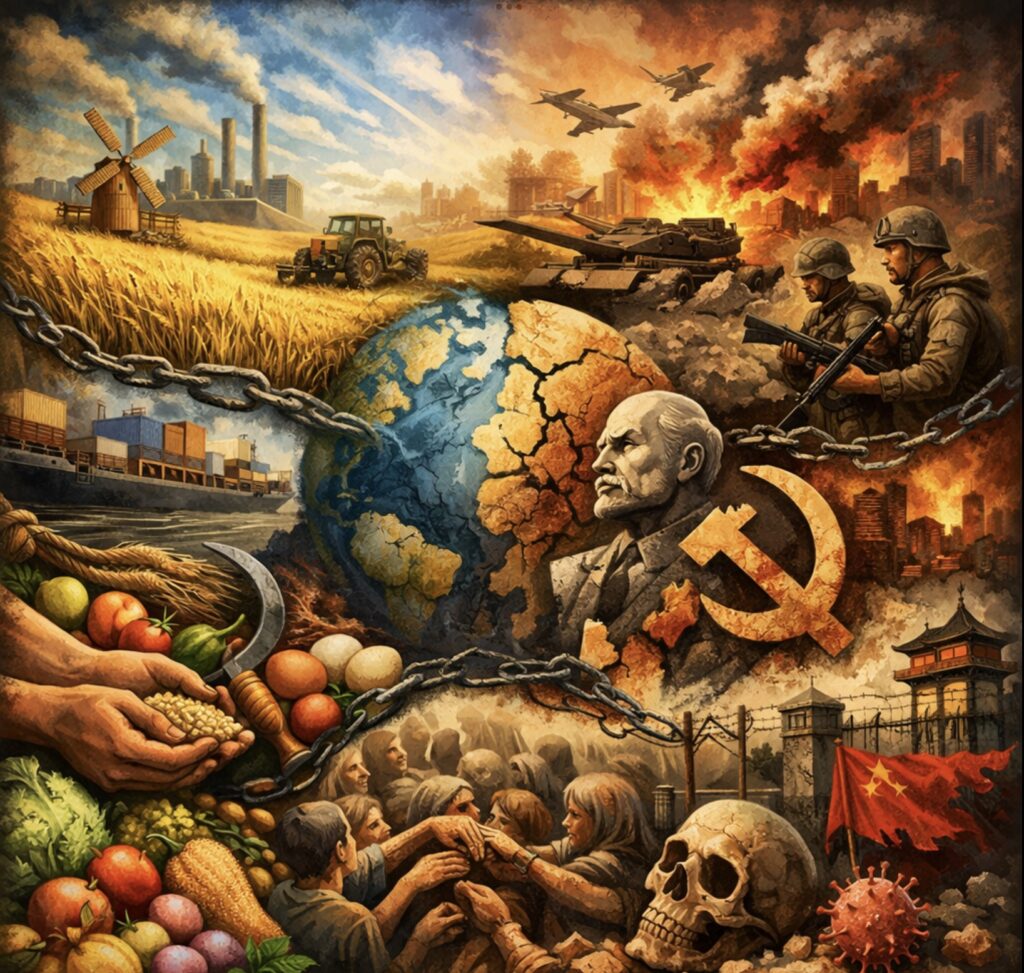
ChatGPT:
When we think of the driving forces behind human history, we usually think of war, religion, politics, technology, or money. But beneath all that noise is something far more primal, far more consistent, and far easier to underestimate: food.
That’s right. From the dawn of Homo sapiens to the fall of the Soviet Union, food—or the desperate lack of it—has shaped the rise and fall of empires, fueled revolutions, and exposed the limits of ideology. We don’t usually talk about it, but for most of history, the central human problem wasn’t discovering gravity or inventing the iPhone. It was what’s for dinner?
Let’s take a quick tour through history’s pantry and see how everything—from philosophy to communism—can be boiled down to a surprisingly consistent ingredient: calories.
⸻
For 50,000 Years, Civilization Was Just a Fancy Word for ‘We Need to Eat’
Until about 200 years ago, almost every human society was obsessed with food. Not because they were foodies or amateur chefs—but because they had no choice. Hunting, gathering, farming, herding, storing, protecting, and trading food wasn’t just one part of life. It was life.
Take ancient Rome. We remember emperors and armies, but the real genius of the Roman Empire was its ability to acquire farmland and build a continent-wide logistics network to ship wheat, olive oil, and wine. Roads weren’t just for marching troops—they were for feeding the empire.
Even religion and philosophy often revolved around food rituals, seasonal harvests, or divine control of rain and fertility. Kings didn’t stay kings if the grain rotted. Societies didn’t survive if the harvest failed. And most people—90% or more—spent their entire lives directly involved in getting food to their mouths or someone else’s.
It wasn’t until the industrial revolution, around the 1800s, that agriculture became mechanized and food production finally—finally—got efficient enough to free up human energy for other things. And even now, in our supermarket-saturated world, food scarcity is just a few shocks away: a bad harvest, a war, a broken supply chain—and we’re right back to panic-buying canned beans.
⸻
Wars: Often Fought for Land, Always Fought for Food
Sure, wars are wrapped in flags, honor, and speeches about freedom—but let’s not kid ourselves. Most ancient wars were about farmland and the people needed to work it. That’s not cynical—it’s just agriculture.
• The Punic Wars? Rome and Carthage fighting over Sicily—grain capital of the Mediterranean.
• Napoleon’s disaster in Russia? Largely a logistics and supply failure.
• Modern invasions? Often about access to resources—land, water, food, or energy.
And when wars happen, they don’t just kill soldiers. They wreck food systems. Crops get burned, infrastructure gets bombed, labor disappears. The war doesn’t just cause death directly—it triggers famine, and famine multiplies the death toll.
In the 19th century, China’s Tai Ping Rebellion killed an estimated 20–30 million people. Only a fraction died in combat. The rest starved as war ruined the fields and choked the food supply.
So when people say “wars over food,” they’re not being dramatic. They’re being historically accurate.
⸻
Food and Philosophy: Even Karl Marx Agreed It’s What’s for Dinner
From a philosophical angle, food is not just a necessity—it’s the foundation of how humans think, organize, and build society. Let’s bring in the old master of historical analysis: Karl Marx.
Marx argued that every society is built on a foundational layer he called the economic base—the way people produce what they need to survive. On top of that is the superstructure—culture, politics, religion, laws, philosophy. In other words, how we eat shapes how we think.
Change the food system, and you change society.
• Move from hunting to farming? You get kings, cities, priests, taxes.
• Move from farming to factories? You get capitalism, wage labor, urban life.
• Move from capitalist to… something better? That was Marx’s big hope: socialism, then communism.
But here’s where things get messy. Marx believed revolutions would happen in wealthy industrial societies, where the working class (proletariat) was developed and exploited. But in real life?
⸻
The Soviet Union and Maoist China: When You Try to Skip Dinner
Communist revolutions happened not in rich, industrial nations—but in agrarian societies that were still struggling to feed themselves.
• Russia (1917): Mostly peasants, barely industrialized.
• China (1949): Even more rural, even more food insecure.
So instead of building socialism on top of a modern industrial base (as Marx predicted), Lenin and Mao tried to force the base to change. They didn’t wait for history—they grabbed it by the throat.
And it backfired—horribly.
• In the Soviet Union, Stalin’s collectivization program seized farmland and created state-run farms. It also caused massive famines, especially in Ukraine. Millions died.
• In China, the Great Leap Forward was supposed to modernize agriculture and industry in one go. Instead, it caused one of the worst famines in human history. Over 30 million people died.
These weren’t just “bad policies.” They were attempts to rewrite the entire economic base of society overnight, using ideology instead of realism. And when the food system collapsed, the whole thing came down with it.
⸻
Why Communism Collapsed (Spoiler: It’s the Food Again)
Beyond the famine disasters, both the USSR and Maoist China ran into another problem: they had no incentive structure to improve productivity.
Workers weren’t rewarded for working harder. Innovation stalled. Agriculture was underfunded. Party elites hoarded what little resources existed. And behind all of it, the propaganda machine kept telling everyone that things were going great—while the bread lines grew longer.
Eventually, the system broke.
• The Soviet Union collapsed in 1991 under the weight of its inefficiency, economic stagnation, and inability to provide basic goods—including food—for its people.
• China took a different route. After Mao’s death, Deng Xiaoping introduced not-communism-but-kind-of-capitalism, letting markets and private farming return. Starvation rates dropped. The economy exploded. Marx wasn’t mentioned.
In both cases, the dream of a food-secure, classless society hit the cold wall of agricultural failure.
⸻
Final Thoughts: It’s Still About Food
Whether you’re an emperor, a revolutionary, or just someone trying to microwave leftovers, food has always been the real main character of history. It determines how we live, what we value, who holds power—and who survives.
Yes, we have AI and space programs now. But remember: civilization is only three missed meals away from chaos. The supermarket shelves may look stable, but they sit on a global supply chain balanced like a Jenga tower on a trampoline.
So the next time you think about history—or the future—don’t just look at the kings and ideologies. Follow the food. It always tells the real story.
And maybe, just maybe, appreciate your next sandwich a little more.