
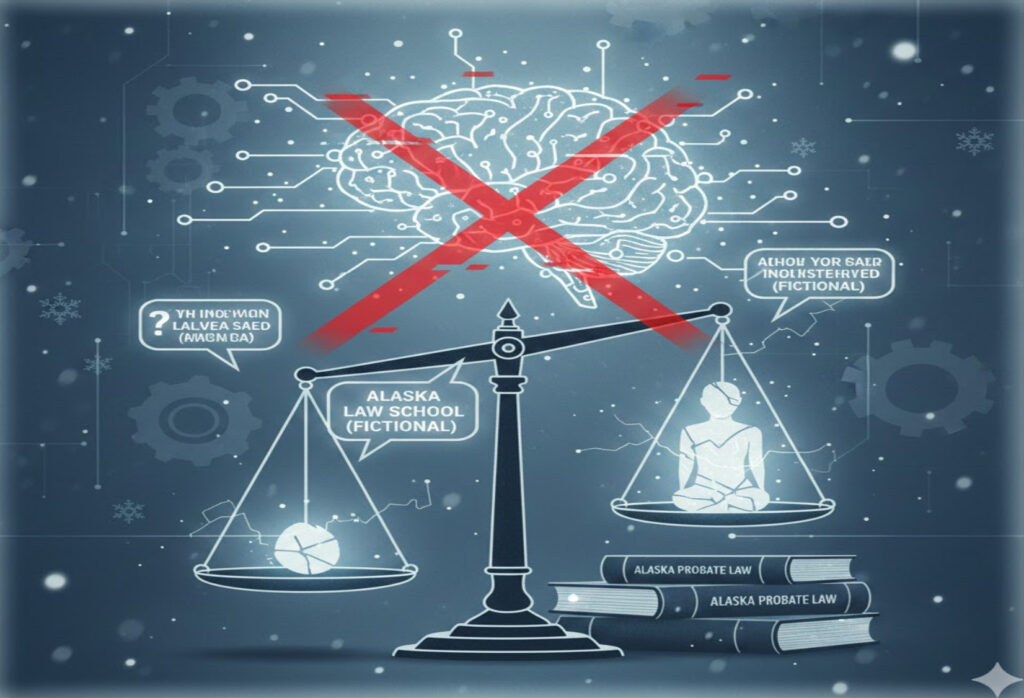
Gemini:
The Precision Paradox: Lessons from Alaska’s AI Journey
In the popular imagination, Artificial Intelligence is often viewed as an all-knowing digital oracle. We ask it to write a poem, summarize a meeting, or generate a recipe, and it responds with startling fluency. However, as the Alaska Court System recently discovered, there is a vast chasm between a “fluent” AI and a “reliable” one.1 Their project, the Alaska Virtual Assistant (AVA), designed to help grieving citizens navigate the complex legal web of probate, provides a sobering case study in the challenges of deploying Large Language Models (LLMs) in high-stakes, deterministic environments.
The Clash of Two Worlds
To understand why AVA’s journey “didn’t go smoothly,” we must first recognize a fundamental technical conflict. LLMs, by their very nature, are probabilistic.2 They do not “know” facts; they predict the next most likely word in a sequence based on mathematical patterns learned from trillions of sentences. In contrast, the legal system is deterministic. In law, there is usually a “right” form to file and a “correct” procedure to follow. There is no room for probability when it is 100% vital to be accurate.
This “Precision Paradox” is the primary hurdle for any government agency. As Stacey Marz, administrative director of the Alaska Court System, noted, while most technology projects can launch with a “minimum viable product” and fix bugs later, a legal chatbot cannot. An incorrect answer regarding an estate or a car title transfer can cause genuine financial and emotional harm to a family already in crisis.
The “Alaska Law School” and the Hallucination Problem
One of the most persistent challenges discussed by AI researchers is the hallucination—a phenomenon where the AI confidently asserts a falsehood.3 During testing, AVA suggested that users seek help from an alumni network at an Alaska law school.4 The problem? Alaska does not have a law school.
This happened because of a conflict between two types of knowledge. The model has “parametric knowledge”—general information it learned during its initial training (like the fact that most states have law schools).5 Even when researchers use Retrieval-Augmented Generation (RAG)—a technique that forces the AI to look at official court documents before answering—the model’s internal “hunches” can leak through. This “knowledge leakage” remains a significant area of research, as developers struggle to ensure that the AI prioritizes the “open-book” facts provided to it over its own internal statistical guesses.
The Difficulty of “Digital Empathy”
Beyond factual accuracy, the Alaska project highlighted a surprising socio-technical challenge: the AI’s personality. Early versions of AVA were programmed to be highly empathetic, offering condolences for the user’s loss. However, user testing revealed that grieving individuals found this “performative empathy” annoying. They didn’t want a machine to tell them it was “sorry”; they wanted to know which form to sign.
For AI researchers, this highlights the difficulty of Alignment. Aligning a model’s “tone” is not a one-size-fits-all task. In a high-stakes environment like probate court, “helpfulness” looks less like warmth and more like clinical, step-by-step precision. Striking this balance requires constant technical tweaks to the model’s “persona,” ensuring it remains professional without becoming cold, yet helpful without becoming insincere.
The “Last Mile” of Maintenance: Model Drift
Perhaps the most invisible challenge is what researchers call Model Drift. AI models are not static; companies like OpenAI or Meta constantly update them to make them faster or safer.6 However, these updates change the underlying “weights”—the mathematical values that determine how the AI processes a prompt.
A prompt that worked perfectly on Monday might produce an error on Tuesday because the model’s “brain” was updated overnight. This creates a massive “Hidden Technical Debt” for agencies. They cannot simply build a chatbot and leave it. They must engage in constant Prompt Versioning and “Regression Testing”—repeatedly asking the same 91 test questions to ensure the AI hasn’t suddenly “forgotten” a rule or developed a new hallucination. This makes AI development far more labor-intensive and expensive than many initial hype cycles suggest.
Conclusion: Toward a More Cautious Future
The story of AVA is not one of failure, but of necessary caution. It serves as a reminder that “democratizing access to justice” through AI is a grueling engineering feat, not a magic trick. For AI to succeed in high-stakes environments, we must move away from the “move fast and break things” mentality of Silicon Valley and toward a “measure twice, cut once” philosophy of judicial engineering.
As we move forward, the focus of AI research will likely shift from making models “smarter” to making them more “verifiable.” The goal is a system that knows exactly what it knows, and—more importantly—is brave enough to admit when it doesn’t have the answer. Until then, the human facilitator remains the gold standard for reliability in the face of life’s most difficult legal challenges.
Best Practices for Government AI Adoption: The Alaska Framework
The journey of the Alaska Virtual Assistant (AVA) provides a blueprint for what to expect—and what to avoid—when deploying AI in high-stakes public services. For government agencies, “success” is defined not by how fast a tool is launched, but by how reliably it protects the citizens it serves.
Based on the challenges of precision, hallucinations, and model drift, here are five best practices for agencies looking to adopt generative AI.
1. Shift from “Chatbot” to “Verifiable Expert”
Most public-facing AI failures occur because the model is allowed to “guess.” Agencies must move away from general-purpose AI and toward a strict grounding architecture.
- The Rule: Never allow an LLM to answer using its general training data alone.
- Action: Implement Retrieval-Augmented Generation (RAG) that forces the AI to cite specific page numbers and paragraphs from official government PDFs for every claim it makes. If the answer isn’t in the provided text, the AI must be programmed to say, “I don’t know,” and redirect the user to a human.
2. Establish a “Golden Dataset” for Continuous Testing
As the Alaska team discovered, you cannot test an AI once and assume it’s finished. Models change as providers update their backends.
- The Rule: Build a permanent library of “edge cases” (the most difficult or common questions).
- Action: Create a Golden Dataset of 50–100 questions where the “correct” answer is verified by legal experts. Every time the model is updated or a prompt is changed, re-run this entire dataset automatically. If the accuracy drops by even 1%, the update should be blocked.
3. Prioritize “Clinical Utility” Over “Social Empathy”
In a crisis—like probate or emergency services—users want efficiency, not a digital friend. Over-engineered empathy can feel insincere or even frustrating to a grieving citizen.
- The Rule: Align the AI’s persona with the gravity of the task.
- Action: Design a “Clinical” persona. Use clear, concise language and minimize social pleasantries. The goal is to reduce the “cognitive load” on the user, providing the answer as quickly and clearly as possible without the “fluff” that can lead to misinterpretation.
4. Implement a Mandatory “Human-in-the-Loop” Audit
AI should augment public servants, not replace the final layer of accountability.
- The Rule: No high-stakes AI output should be considered “final” until the underlying system has been audited by a subject matter expert.
- Action: Designate a Chief AI Ethics Officer or a legal review team to periodically audit “live” conversations. This ensures that subtle drifts in tone or logic are caught before they become systemic legal liabilities.
5. Adopt a “Prompt Versioning” Strategy
Treat your AI instructions like software code. A simple change in how you ask the AI to behave can have massive downstream effects.
- The Rule: Never edit a “live” prompt without a rollback plan.
- Action: Use Prompt Versioning tools to track every change. If a new version of the chatbot starts hallucinating (like suggesting a non-existent law school), your technical team should be able to “roll back” to the previous, stable version in seconds.
Summary Table: The Government AI Readiness Checklist
Category Requirement Goal Accuracy Citations for every claim Eliminating Hallucinations Stability Automated Regression Testing Preventing Model Drift Ethics Human Audit Logs Accountability UI/UX Fact-First Persona Reducing User Frustration