
ChatGPT:
From Desert Dreams to Ancient Rivers: Fifty Years of Exploring Mars
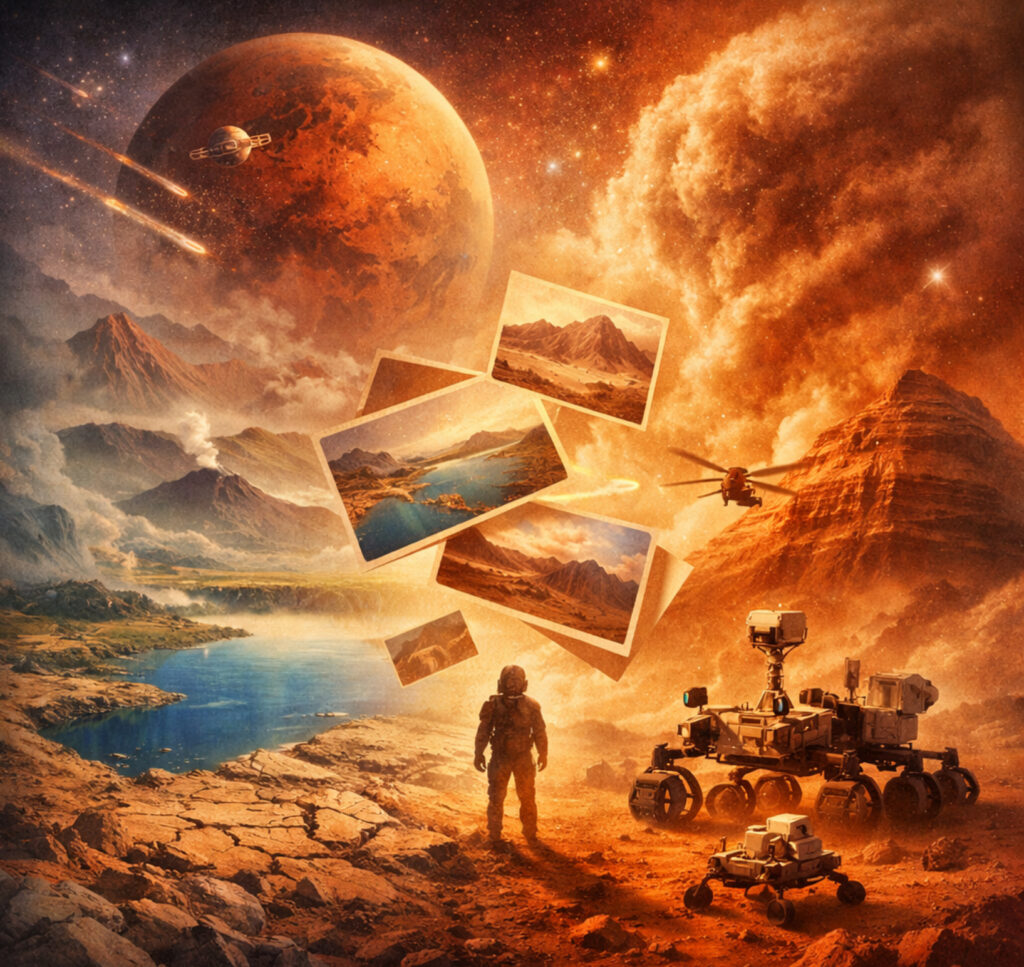
For much of human history, Mars was a canvas for imagination. Its reddish hue suggested fire, war, or perhaps a dying world still clinging to life. In From Mars with Love: Postcards from 50 Years of Exploring the Red Planet, astronomer Chris Lintott recounts how half a century of robotic exploration replaced fantasy with evidence—and in the process revealed a planet far more complex than anyone expected. Presented at Gresham College, the lecture tells Mars’s story mission by mission, each like a postcard sent back across space.
What emerges is not a tale of disappointment, but of deepening wonder: Mars is no longer seen merely as a cold desert, but as a world with a dramatic past—one that helps us understand how planets live, change, and sometimes fail.
1. Viking 1 and 2 (1976): The First Close Look
The modern story begins with NASA’s Viking missions, the first to place orbiters and landers on Mars. Viking returned stunning images of vast canyons, volcanoes, and dry channels carved by flowing liquid. On the surface, its landers performed the first experiments designed to detect life.
The verdict was sobering. Mars appeared cold, arid, and hostile, with no conclusive evidence of biology. For many, this felt like the end of a dream. Yet Viking quietly planted a more important seed: the unmistakable signs that water had once shaped the planet.
2. Mars Pathfinder and Sojourner (1997): Learning to Rove
After nearly two decades of relative quiet, Mars exploration resumed with Mars Pathfinder and its tiny rover, Sojourner. This mission proved that mobile exploration was possible and affordable. Sojourner trundled over rocks, analyzed soil, and showed that Mars had a solid iron core and extreme weather swings.
More than any single discovery, Pathfinder demonstrated that Mars could be explored not just by landing, but by moving—and that changed everything.
3. Spirit (2004–2010): A Friendly Past Revealed
Spirit, one of two twin rovers launched in 2003, landed in Gusev Crater, thought to be a dried lake bed. After years of travel, Spirit uncovered carbonate minerals formed in warm, non-acidic water. These findings suggested that early Mars was not only wet, but potentially comfortable for life.
Spirit far outlived its planned mission, a testament to both engineering resilience and scientific payoff.
4. Opportunity (2004–2018): Water, But Harsh
Opportunity, Spirit’s twin, told a complementary story. Exploring a crater rich in exposed bedrock, it found tiny hematite “blueberries,” minerals that form in water—but under acidic conditions. Mars, it seemed, had water for long periods, but not always in environments friendly to life.
Together, Spirit and Opportunity replaced the question “Was there water on Mars?” with a richer one: What kind of water, and for how long?
5. Phoenix (2008): Ice Beneath Our Feet
Phoenix landed near the Martian north pole to answer a simpler question: is there water today? The answer was yes. Phoenix directly sampled water ice just beneath the soil and identified perchlorate salts—chemicals hostile to life, but capable of preserving organic molecules.
Phoenix helped explain why Viking’s life-detection results were so confusing, and confirmed that Mars still stores water, albeit frozen.
6. Mars Reconnaissance Orbiter (2006–present): Mars in High Definition
Orbiting above all these surface missions, the Mars Reconnaissance Orbiter transformed how we see the planet. Its HiRISE camera can resolve features as small as rover tracks, revealing dunes, landslides, and seasonal changes in extraordinary detail.
Mars was no longer a blurry world—it became a place geologists could read almost rock by rock.
7. Curiosity (2012–present): Was Mars Habitable?
Curiosity marked a leap in scale and ambition. Using the dramatic “sky crane” landing system, it touched down in Gale Crater and began climbing Mount Sharp, a layered record of Martian history. Curiosity found all the chemical ingredients needed for life and clear evidence that the crater once hosted long-lived lakes.
Mars, Curiosity showed, was not just wet—it was habitable.
8. InSight (2018–2022): Listening to the Planet
InSight did not roam. Instead, it listened. By measuring Marsquakes, InSight revealed the structure of Mars’s crust, mantle, and core. This geophysical insight explained why Mars lost its magnetic field and atmosphere so early—key reasons the planet became cold and dry.
9. ExoMars Trace Gas Orbiter (2016–present): Atmospheric Mysteries
While American missions dominated the surface, Europe focused on the sky. The ExoMars Trace Gas Orbiter studied the chemistry of Mars’s atmosphere, including the puzzling absence of methane—despite hints detected by Curiosity. Mars’s atmosphere, it turns out, is still full of surprises.
10. Perseverance (2021–present): Searching for Life’s Fingerprints
The most recent chapter is Perseverance, exploring Jezero Crater, once a river delta. Its mission is to collect samples for eventual return to Earth. Intriguing rock patterns hint at possible biological processes, but definitive answers must wait until those samples come home.
A Planet That Teaches Us About Worlds
Across fifty years, Mars has gone from imagined twin to cautionary tale. It teaches us that planets can change radically, that habitability is fragile, and that Earth’s stability is not guaranteed. By reading Mars’s past, we glimpse possible futures—not just for other planets, but for our own.
Mars may be silent, but its postcards keep coming—and we are still learning how to read them.