
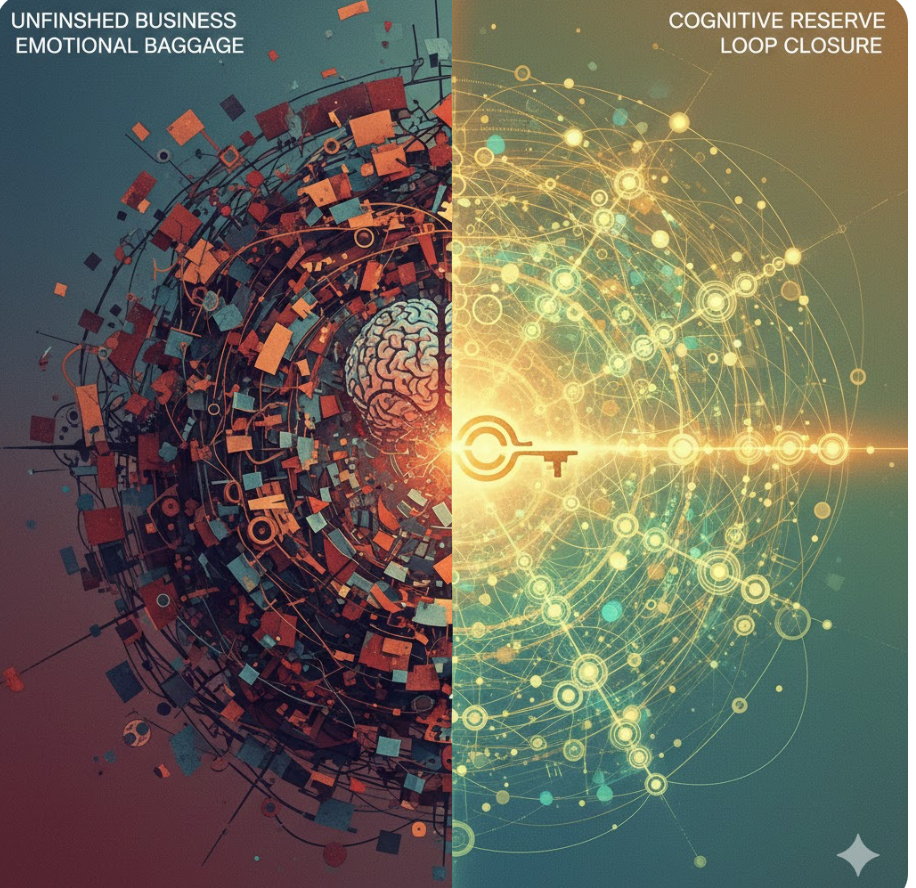
Gemini:
The “Mental Itch”: Why Unfinished Business is the Greatest Thief of Healthy Aging
We have all felt it: that nagging “mental itch” when you leave a task half-done. Whether it’s a crossword puzzle sitting on the coffee table or a difficult conversation you never finished with a sibling, our brains have a peculiar—and sometimes exhausting—way of clinging to the “incomplete.”
In the world of neuroscience, this isn’t just a quirk of personality; it is a fundamental way our brain manages energy. For seniors, understanding how these “open loops” work is the secret to protecting one of our most precious assets: Cognitive Reserve.
1. The Science of the “Open Loop”
To understand how unfinished business drains us, we first look at two foundational psychological principles:
- The Zeigarnik Effect (The Memory Loop): Named after psychologist Bluma Zeigarnik, this explains why we remember uncompleted tasks far better than finished ones.1 When a task is started, your brain creates “neuro-tension.” It keeps the details in your “mental RAM” (working memory) so you don’t forget to finish it. Once the task is done, the brain “flushes” the data to make room for something else.
- The Ovsiankina Effect (The Resumption Urge): This is the behavioral sibling to Zeigarnik. It is that almost compulsive urge to go back and finish what you started. It’s driven by your brain’s conflict monitor—the Anterior Cingulate Cortex (ACC)—which views an unfinished task as an “error” that needs fixing.
2. When the “Itch” Becomes a “Leak”: The Impact of Aging
As we age, the neurobiological systems that manage these loops undergo significant changes. In healthy aging, these effects can actually help us stay organized. However, when cognitive decline enters the picture, the system begins to “leak”:
- Weakened Signaling: The “itch” to finish a task becomes quieter. The ACC may no longer signal the “error” of an unfinished chore as loudly, leading to what looks like forgetfulness but is actually a failure of internal tension.
- Attention Residue: This is the “fog” left behind. When a senior is interrupted, their brain doesn’t “reset” efficiently. A portion of their cognitive energy remains stuck on the previous task. This “attention residue” clutters the mind, making the next task feel twice as difficult.
- Reduced “RAM”: Since unfinished tasks take up active space in the Prefrontal Cortex, a senior with a “leaky” memory has less available space for new information.2
3. Emotional Baggage: The Ultimate Unfinished Task
Perhaps the most overlooked “open loop” in gerontology is emotional baggage. From a brain’s perspective, an unresolved regret or a long-standing grudge is simply a high-priority unfinished task.
- The Neuro-Price of Regret: Unresolved emotional conflicts keep the brain’s stress system (the HPA axis) on low-grade alert. This keeps cortisol levels high, which can be toxic to the Hippocampus—the very center of memory and learning.
- The Persistence of the Loop: Because emotional “tasks” (like seeking forgiveness or processing grief) are complex, the brain may ruminate on them for decades. This is the Ovsiankina Effect gone wrong—the brain keeps “re-playing” the event to find a solution that isn’t there, wasting vast amounts of neural energy.
4. The Cognitive Reserve Connection
Today, the “Gold Standard” for aging well is building Cognitive Reserve. Think of this as your brain’s “savings account”—a surplus of neural connections that allows you to keep functioning even if some brain cells are lost to age.
Here is the catch: Unfinished business is like a hidden fee draining your savings account.
- Neural Competition: You cannot easily build new “neural detours” (the essence of reserve) if your brain is constantly using its resources to suppress old emotional baggage or manage a cluttered list of unfinished chores.
- The Plasticity Problem: Chronic stress from “open loops” lowers BDNF, the “brain fertilizer” that allows us to learn new things. To build reserve effectively, we need a “quiet” brain that isn’t bogged down by the past.
5. Closing the Loops: A Practical Guide for the Public
How do we stop the leak and start building reserve? We must move from internal monitoring to external closure.
- Externalize the Loop: Since the internal “itch” is weakening, use physical tools. Checklists, whiteboards, and “visual breadcrumbs” (leaving a tool out to remind you of a task) act as an external ACC, guiding you back to completion without draining your mental energy.
- The “Shut-Down” Ritual: Never leave a task half-done without a “plan.” If you must stop, write down exactly where you left off. This signals your brain that the task is “managed,” allowing the Prefrontal Cortex to release the data and clear the residue.
- Narrative Completion (Healing the Baggage): For emotional loops, use Life Review. Telling your story, writing letters (even unsent ones), and practicing “Meta-Closure” (accepting that some loops cannot be perfectly closed) helps the brain move emotional “tasks” into “long-term storage.”
- Prioritize “Clean Slates”: Before starting a new cognitive challenge—like learning a language or a new hobby—take a moment to close the small loops of the day. A clear mental “RAM” is the best environment for building a resilient, high-reserve brain.
The Bottom Line: Aging well isn’t just about adding new skills; it’s about clearing out the old clutter. By closing our physical and emotional “open loops,” we stop the cognitive leak, lower our stress, and free up the neural energy we need to live a vibrant, engaged, and sharp later life.
This 5-minute “Loop Clearing” ritual is designed to transition the brain from an active, “goal-seeking” state to a restful, “maintenance” state. By externalizing your unfinished business, you satisfy the Anterior Cingulate Cortex (ACC) and prevent Attention Residue from keeping you awake or draining your morning energy.
🌙 The 5-Minute “Loop Clearing” Checklist
Step 1: The “Physical Flush” (2 Minutes)
The goal here is to satisfy the Ovsiankina Effect by acknowledging physical unfinished tasks.
- The Sweep: Walk through your main living area. If you see a “started” task (a half-folded pile of laundry, an open book, a dish in the sink), do not necessarily finish it now.
- The “Breadcrumb”: If the task is too big to finish, place a physical marker on it (e.g., put the laundry detergent on top of the pile) or write it on a Tomorrow List.
- Neuro-Benefit: This signals the brain that the “error” has been noted and a plan is in place, allowing the Prefrontal Cortex to release the tension.
Step 2: The “Mental RAM” Dump (2 Minutes)
This addresses the Zeigarnik Effect—the tendency to remember what is undone.
- The Brain Dump: Grab a notepad. Write down the 3 “niggling” things currently in your mind.
- Example: “Need to call the pharmacy,” “Didn’t finish that email to the kids,” “Must buy lightbulbs.”
- The “Meta-Closure”: Next to each item, write a specific time tomorrow when you will handle it.
- Neuro-Benefit: Research shows that writing a plan for a task is almost as effective at reducing cognitive arousal as actually finishing the task.
Step 3: The “Emotional Reset” (1 Minute)
This addresses the high-priority “emotional loops” that can drain Cognitive Reserve.
- The Exhale: Identify one frustration or social “hiccup” from today (e.g., a misunderstood comment or a minor irritation).
- The Internal Script: Say to yourself (or write): “This loop is paused for tonight. I am safe, and this story is not going to change between now and morning.”
- Neuro-Benefit: This intentional inhibition strengthens your GABAergic “brakes,” quieting the Amygdalaand preventing emotional baggage from triggering overnight cortisol spikes.
💡 Why This Works for Seniors
As we discussed, cognitive decline makes the brain less efficient at “cleaning up” after itself. By doing this ritual:
- You free up working memory: You go to sleep with a “clean slate,” which improves sleep quality (the time when the brain washes away metabolic waste).
- You protect your Hippocampus: By lowering cortisol before bed, you create the optimal environment for neural repair.
- You build Neural Efficiency: Consistent “loop clearing” is a form of cognitive training that strengthens the connection between your ACC and your Prefrontal Cortex, directly contributing to your Cognitive Reserve.