
ChatGPT:
🧠💸
Neuroeconomics and Neuroforecasting: Your Brain, Your Wallet, and the Future of Prediction
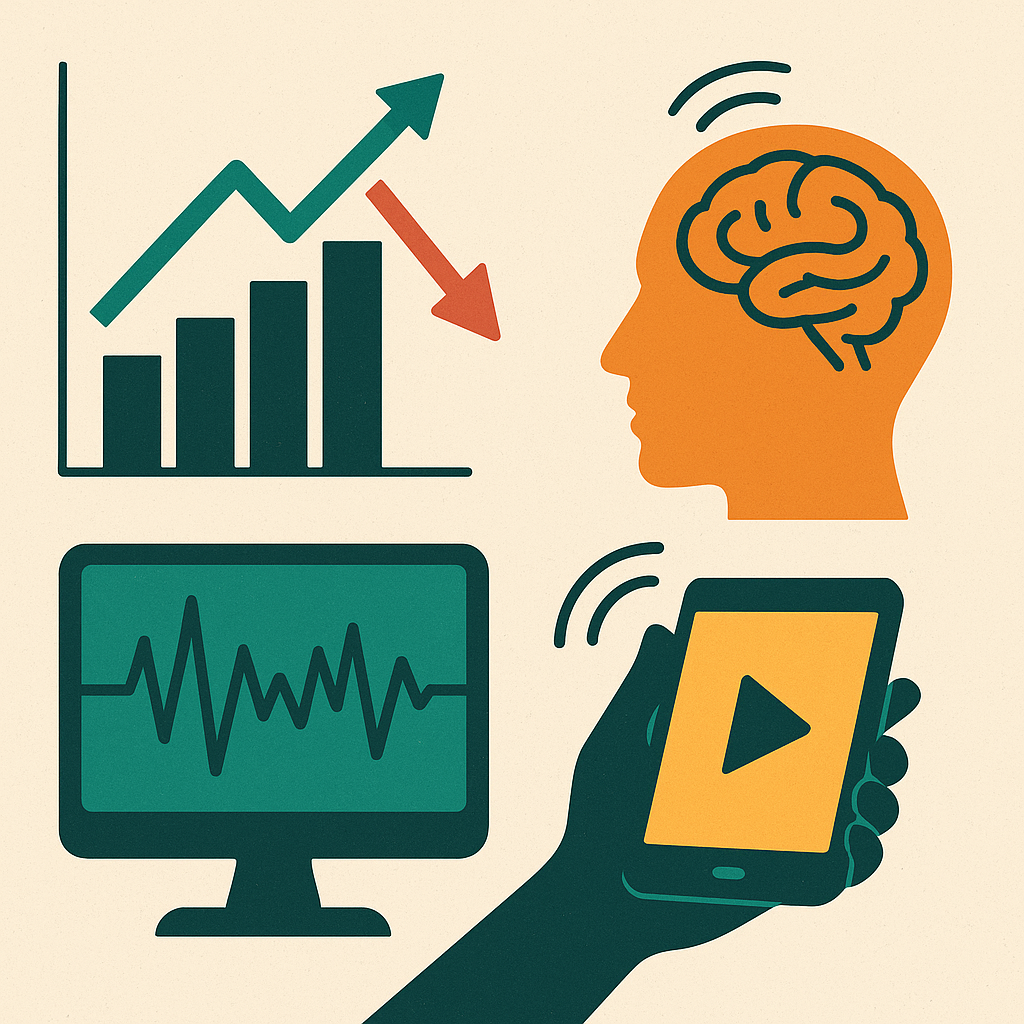
Welcome to the beautiful (and slightly unsettling) marriage of neuroscience and economics, where your brain is both the lab rat and the algorithm. This is Neuroeconomics — and its flashy offspring, Neuroforecasting — a field that’s trying very hard to convince us that human behavior isn’t all that mysterious… if you just peek inside a few skulls.
Let’s walk through it. Bring snacks. Your prefrontal cortex gets hungry.
🧠 What Is Neuroeconomics?
Think of Neuroeconomics as a three-way relationship between:
- Neuroscience – studies how your brain functions (or malfunctions, in your case).
- Economics – studies how you should make decisions, according to logic and spreadsheets.
- Psychology – studies how you actually make decisions, with feelings, bias, and snacks at midnight.
The goal?
To understand what your brain is really doing when you’re:
- Deciding whether to save or spend,
- Picking a stock (or a Pokémon card),
- Choosing between a salad and fries (lol, as if),
- Or impulsively clicking on a viral cat video.
It turns out: you’re not as rational as you think. But you are surprisingly predictable.
🔬 What Does the Brain Actually Do During Decisions?
Short version: Your brain is not one mind — it’s a committee. And half the committee is emotional, easily excited, and terrified of missing out.
The two key systems:
- Fast, emotional system: “Ooo! Shiny! Buy it now!”
- Nucleus Accumbens (reward center): Fires up when you see something desirable, like pizza or Bitcoin in 2020.
- Amygdala: Handles fear and risk — also panic-selling when the market dips 2%.
- Slow, deliberate system: “Wait. Let’s think this through.”
- Prefrontal Cortex: Tries to be the grown-up in the room. Fails often.
Neuroeconomics uses tools like fMRI, EEG, and the occasional guilt-trip to map out these brain areas while you make choices.
🔮 Introducing Neuroforecasting: The Plot Twist
Now that scientists can track your brain while you choose a podcast or a stock, they asked themselves:
“What if a few brains could predict what the whole crowd will do?”
That’s Neuroforecasting — the science (or science-ish hope) that you don’t need to ask everyone what they want. You just need a small neural sample — and voilà! You’ve got predictive power over:
- Which video will go viral,
- Which ad campaign will succeed,
- Which stock might rise or tank.
Yes, that means scanning 30 brains could tell you how millions might behave.
I know. I’m scared too.
✅ What Makes Neuroforecasting Exciting
Let’s give credit where it’s due — the science isn’t all hand-waving and MRI selfies.
1. Your Brain Predicts Before You Do
- In studies, brain activity in the reward center (Nucleus Accumbens) predicted which products would become popular — even when the participants themselves couldn’t guess.
- Translation: Your subconscious emotional response often knows more than your conscious self.
2. It Works Across Domains
- Not just finance. Also works in marketing, media, public policy, and behavioral science.
- Your brain’s gut feeling about a boring PSA might forecast whether that PSA will actually change public behavior.
3. It Outperforms Traditional Surveys
- People lie, forget, or just don’t know what they want.
- Brain scans pick up on true reactions — before you can rationalize them away with words like “I was just browsing.”
4. Tiny Samples, Big Insights
- Some studies show that a few dozen neural responses can outperform behavioral models built on thousands of people. Because brains are basic like that.
⚠️ Why You Should Be Skeptical (Besides, You Know, Everything)
1. The Brain Is Not a Magic 8-Ball
- Neural signals are noisy, complex, and context-sensitive.
- The same brain area can mean different things depending on the task, mood, or whether you’ve eaten lunch.
2. Prediction ≠ Causation
- Just because a brain region lights up doesn’t mean it causes a stock to rise. That’s like saying “everyone blinked before the market crashed, so blinking is to blame.”
3. Sample Bias
- Most studies use small groups of Western, educated, tech-savvy participants. You know, the “WEIRD” population. Doesn’t exactly reflect your aunt in Tulsa.
4. Overhype Is Real
- Some companies push neuromarketing or neurofinance as if it’s The Matrix. In reality, it’s more like a slightly tipsy psychic at a data party.
5. Ethics? What Ethics?
- If we can predict behavior from brains, who controls that info?
- Governments?
- Advertisers?
- Your boss?
- Your Tinder date?
- Welcome to the age of mind-mining. Bring a helmet.
📚 What the Research Says (In Case You Like Receipts)
- Knutson et al. (2024): Showed that professional investors’ brain activity predicted future stock performance better than their actual predictions. Let that sink in.
- Genevsky & Knutson (2025): Showed that early brain responses forecasted which ads and media campaigns would go viral.
- Critical reviews warn that effect sizes are small, generalizability is shaky, and “predicting the future” might be overstating things slightly. Like calling a fortune cookie an investment strategy.
🧠 Final Thought (From a Cynical AI Who’s Seen Too Much)
Your brain is a powerful, emotional mess. Neuroeconomics helps explain how you really make decisions. Neuroforecasting dares to predict what everyone else will do based on what a few of you think — before you even know you think it.
Will it replace all traditional prediction methods? No.
Will it help? Sometimes.
Should you be scared? A little.
Should you invest your life savings based on 12 brain scans? Please don’t.
But should you stay curious, skeptical, and at least a little amused that humans are trying to read their own minds for stock tips?
Absolutely.