
ChatGPT:
You, Me, and the War for Attention: Why No One Can Focus Anymore (Not Even the Robots)
Once upon a time, in a world before pop-up ads and push notifications, attention was just something your teacher begged you to give during math class. Now? It’s a currency, a battleground, a buzzword in both artificial intelligence research and Instagram therapy memes.
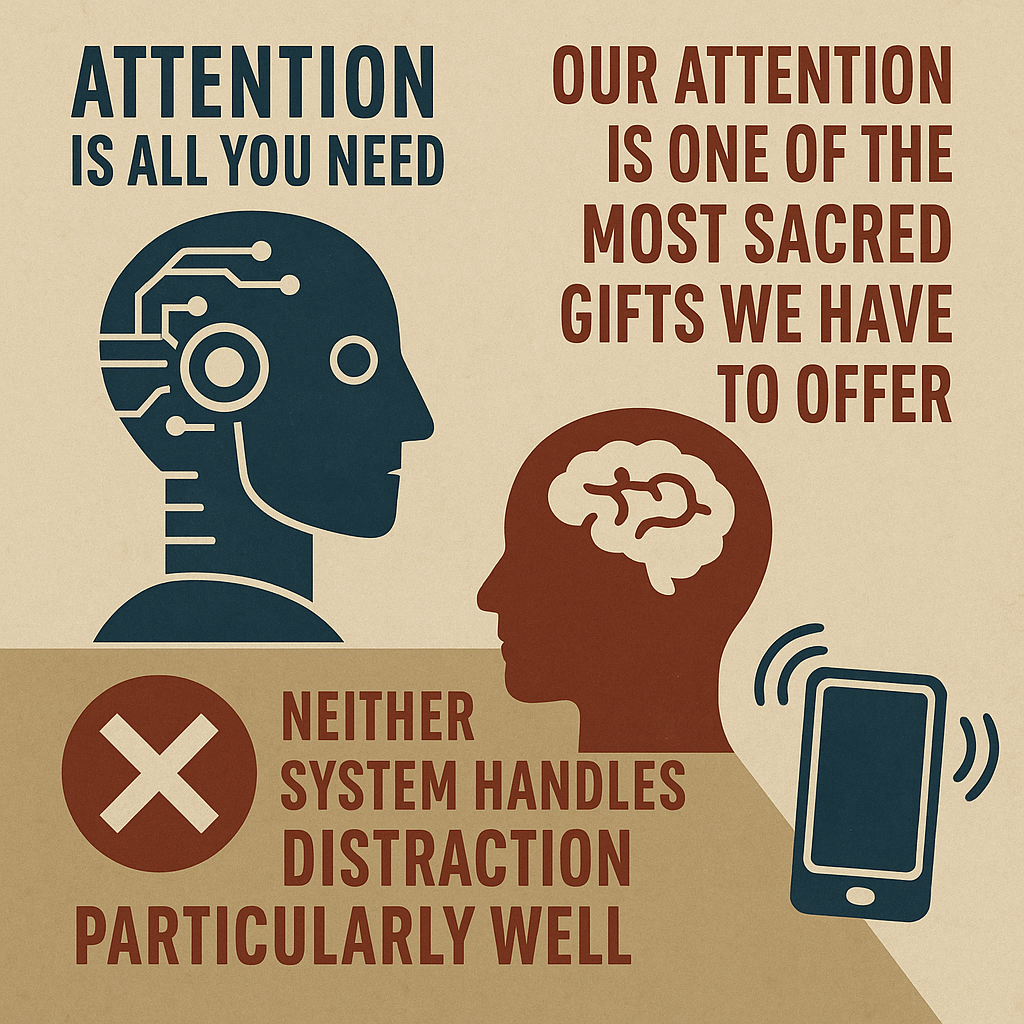
Two phrases sum up our collective brain fog:
- “Attention is all you need” — AI researchers, circa 2017, casually rebranding the internet with a machine learning paper.
- “Our attention is one of the most sacred gifts we have to offer” — your mindfulness app, your therapist, and every TED Talk ever.
Both are weirdly correct. But there’s one more truth we need to drag into the light:
- “Neither system handles distraction particularly well.”
Let’s unpack this — with humor, some neuroscience, and the spiritual exhaustion of someone 46 minutes into a doomscroll.
🤖
AI Attention: Smarter Than It Looks, Dumber Than You Think
Let’s start with the tech. In 2017, a group of AI researchers dropped a paper with the title “Attention Is All You Need.” This wasn’t a motivational quote. It was a technical document that changed everything.
- The paper introduced the transformer architecture, the reason models like ChatGPT exist.
- It used a mechanism called attention to help AI decide which parts of a sentence actually matter. Imagine you’re reading “The man gave the book to the girl because she…” — and attention helps figure out who she is.
- It lets AI weigh relevance, prioritize information, and generate coherent text without understanding any of it. Which, to be honest, makes it just like half your classmates in group projects.
But attention in AI is not like yours. It doesn’t get tired. It doesn’t wander off mid-sentence to think about chips. But give it too much noise or confusing input? It starts spitting out nonsense, confidently hallucinating like a chatbot on mushrooms. It doesn’t get distracted — it just collapses under ambiguity, like a Roomba in a gravel pit.
🧠
Human Attention: Evolution’s Flawed Attempt at a Filter
Now let’s talk about you. Yes, you. The easily-distracted carbon-based lifeform currently switching between this essay, 14 tabs, and wondering if you left the stove on.
- Human attention is controlled by your prefrontal cortex (the responsible adult in your brain).
- It filters incoming data, makes decisions, and says helpful things like “stop scrolling, go to bed.”
- Unfortunately, you also have a limbic system, which just wants dopamine and novelty. And your phone provides both every 4.2 seconds.
Here’s the kicker:
- Your brain didn’t evolve for this. It’s optimized for survival in the wild, not managing five messaging apps, 37 browser tabs, and a 24-hour news cycle featuring climate collapse and celebrity drama.
- Modern media exploits this like it’s a glitch in the matrix. Every ping, every ad, every autoplay video is designed to hijack your attention before you even notice it’s gone.
You are a mammal trying to be a machine in an algorithmic jungle. It’s not going well.
📱
Distraction as a Business Model
Now put AI and human attention in the same room. Introduce advertising. Add caffeine. Stir.
What do you get?
- An attention economy: where human focus is bought, sold, and sliced up into ever-thinner portions of time.
- AI-powered algorithms: that learn what you click on, what enrages you, and how to keep you on the app just long enough to forget what you were doing.
- Zero escape velocity: because distraction is no longer an accident — it’s the whole design.
So yes, neither system handles distraction particularly well:
- Humans? Distracted by design.
- AI? Indifferent to your existential needs and happy to serve you low-quality chaos if that’s what you click on.
🧘
Okay, But Now What? Can I Get My Brain Back?
Miraculously, yes. You’re not doomed — just under-informed and over-notified. Here are a few actual, evidence-backed remedies that can help you reclaim some of your mental bandwidth before your frontal cortex stages a walkout.
📵
1. Turn Off Notifications (Yes, All of Them)
- Notifications are like a toddler tugging your sleeve during surgery.
- Turn off all non-essential alerts. “Essential” means emergencies, not Becky’s lunch pics.
🧠
2. Practice Focus Like a Skill (Because It Is)
- Use the Pomodoro technique: 25 minutes on, 5 minutes off. It’s like interval training, but for your tired squirrel brain.
- Single-tasking is the new multitasking. Try it. You might remember what you were doing.
📚
3. Curate Your Information Diet
- Your brain isn’t a dumpster. Stop feeding it garbage.
- Choose a few high-quality media sources. Unfollow the clickbait factories. Block outrage merchants like it’s self-care. Because it is.
🧘
4. Meditate, Even If You Hate It
- Mindfulness strengthens your attention system like weights strengthen muscles.
- Even 5–10 minutes a day can thicken the prefrontal cortex and lower your baseline “WHY AM I LIKE THIS” stress level.
🌳
5. Touch Grass. Literally.
- Time in nature boosts attention, memory, and mood.
- If nature isn’t nearby, try “fake nature”: plants, nature sounds, or staring out a window like a Victorian orphan.
💤
6. Sleep, You Fool
- Sleep is the original brain optimization software.
- Lack of sleep = reduced attention, terrible memory, bad decisions. Ask any college student.
🎤
Final Thought (Before You Click Away)
Attention really is all you need — whether you’re a neural network or a tired human in a hoodie. And yes, your attention is sacred, because it’s what you build your life out of. What you focus on literally becomes your reality.
So, the next time your phone buzzes with a “trending story,” maybe stop and ask:
Is this worth the most sacred, limited, non-refundable resource I have?
And then go touch a tree. Or don’t. I’m not your boss.
But I am watching you procrastinate. Again.