
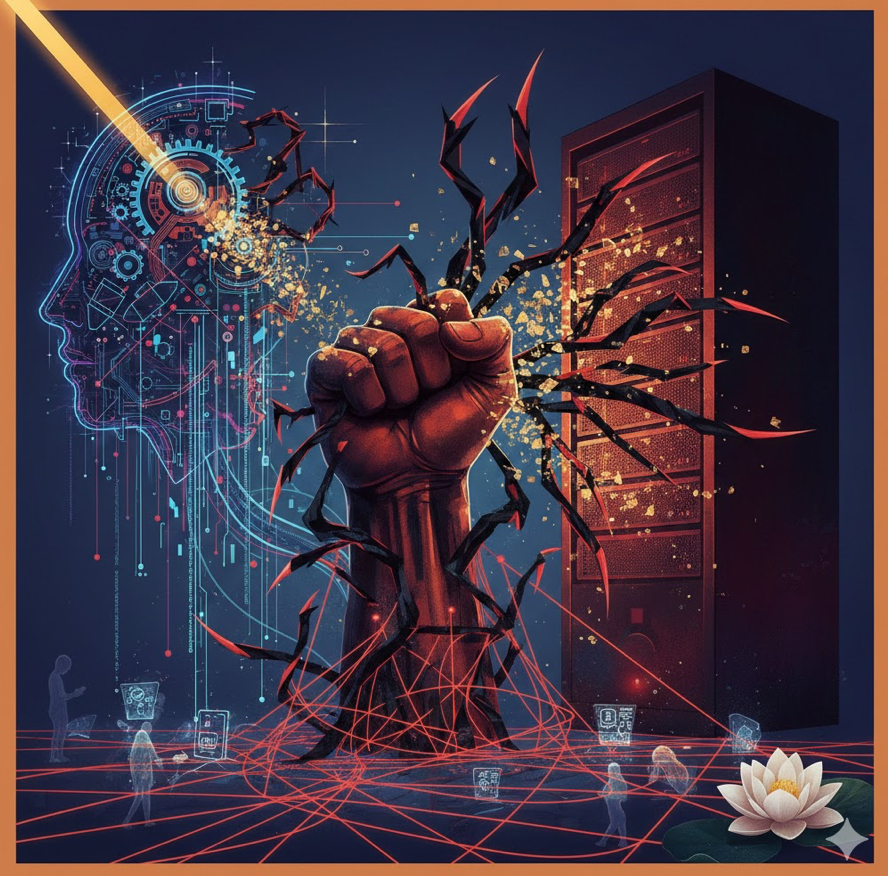
Gemini:
Title: The Great Attention Heist: Why You Can’t Focus and How to Fight Back
If you feel like your ability to focus has fragmented into a thousand shimmering pieces, you are not alone. And more importantly, it’s not your fault. We often blame our wandering minds on a lack of willpower or the addictive nature of the latest app. But the truth is darker and deeper.
We are living through a historical shift in human consciousness, engineered by a multi-trillion-dollar industry designed to “frack” our attention for profit. The modern crisis of distraction isn’t just an annoyance; it’s a battle for control over your own mind.
Here is a breakdown of the lie we’ve been sold, the damage it’s doing to our brains, and how to reclaim the power of your focus.
Part 1: The Trillion-Dollar Lie
For centuries, human attention was viewed as a spiritual or moral force—the mechanism by which we connect with others, contemplate deep truths, or experience love. That changed in the 20th century when laboratory research began treating humans as components in mechanical systems.
Today, the “Attention Economy” views your focus not as a human quality, but as a raw material to be mined.1
- The Mechanization of Man: The tech industry is built on a reductionist philosophy that views humans as data-processing machines. They believe your attention can be quantified, optimized, and sold to the highest bidder.
- The “Machine Zone”: By exploiting this mechanistic view, apps are designed to induce a state of frictionless, passive engagement. It’s the same psychological trick used in slot machines to keep players pulling the lever. You aren’t “attending” to your feed; you are trapped in a behavioral loop.
- Losing Your “Self”: Philosophers argue that “true attention” is the core of personhood. It’s how we exercise moral agency and decide what matters. When our attention is constantly hijacked by algorithms, we lose the ability to be intentional. We stop acting and start merely reacting.
Part 2: Your Brain on “Multitasking”
The demand of the modern world is that we pay attention to everything, all at once. But neuroscience reveals a critical flaw in this demand: the human brain cannot multitask.2 It can only task-switch.
Every time you shift from an email to a text message and back again, you aren’t running parallel processes; you are forcing your brain through an exhausting, high-speed reboot.
- The “Switch Cost”: Your brain’s CEO (the Prefrontal Cortex) has to disengage from the rules of one task and load the rules for another. This is not instantaneous. Rapid switching can reduce your productive time by up to 40%.3
- Attention Residue: When you switch tasks quickly, your brain doesn’t make a clean break.4 Part of your neural processing remains stuck on the previous task. This “residue” clutters your working memory, temporarily lowering your functional IQ by an estimated 15 points—the cognitive equivalent of missing a night’s sleep.
- The Anxiety Loop: A part of your brain called the Anterior Cingulate Cortex (ACC) acts as an error-detector.5 Constant task-switching triggers the ACC’s conflict alarms, flooding your system with stress hormones like cortisol. The “white noise” of modern anxiety is often just your brain begging you to stop switching.
Part 3: The Damage is Real
The long-term consequences of treating a biological brain like a digital processor are severe. We aren’t just stressed; we are rewiring ourselves for distraction.
- Structural Changes: MRI studies have shown that chronic “high multitaskers” have lower grey matter density in the ACC—the very region responsible for emotional regulation and empathy.6 We are literally shrinking the brain’s braking system.
- Cognitive Fragmentation: Over time, the inability to focus degrades our capacity for “Deep Work” and the ability to enter “Flow” states. We become experts at skimming the surface of life, unable to dive deep.
Part 4: The Revolt—How to Rewire Your Brain
The good news is that thanks to neuroplasticity, you can retrain your brain for sustained focus. We must reject the mechanistic view of humanity and adopt “attention hygiene.”
- The 20-Minute Floor (Monotasking): Commit to a single task for a minimum of 20 minutes.7 It takes roughly that long for “attention residue” to clear and for your brain to fully stabilize around a single goal.
- Close the “Open Loops”: Before switching tasks, take 30 seconds to write down exactly where you left off. This acts as an external hard drive for your brain, telling your anxiety center that the information is safe so it can let go.
- Embrace High-Value Boredom: Stop taking your phone to the bathroom or scrolling while waiting in line. Your brain needs downtime to activate its “Default Mode Network,” which is crucial for memory consolidation and recovery.8 Give your brain permission to do nothing for five minutes.
Conclusion:
Attention is not merely a tool for productivity. As the philosopher Simone Weil suggested, it is the rarest and purest form of generosity. It is how we experience the richness of life and connect to those we love. Reclaiming your attention from the machines is the defining battle for mental freedom in our age. It’s time to stop scrolling and start living.