
ChatGPT:
📘 Introduction: What Is This Book and Why Should You Care?
- Stories of Your Life and Others is a collection of speculative short stories by Ted Chiang, first published in 2002.
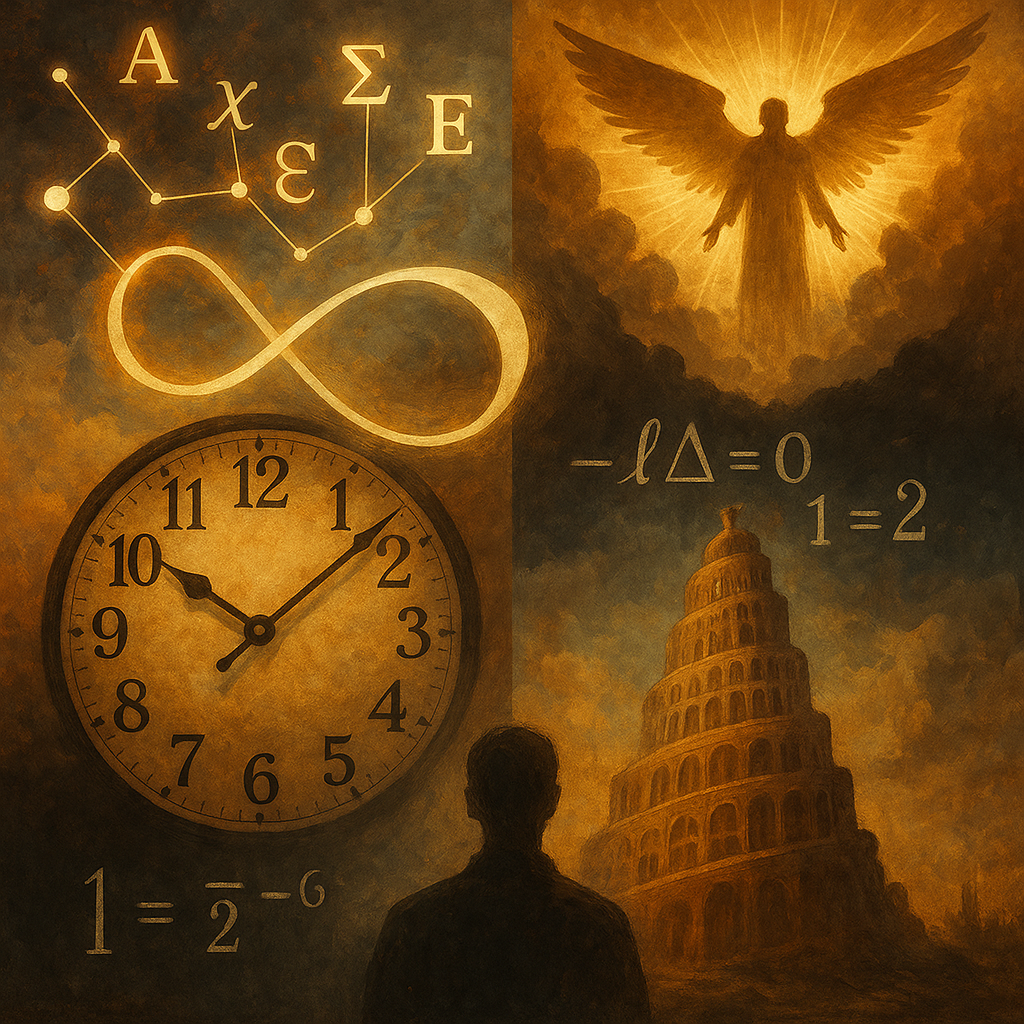
- It’s not your average sci-fi. These stories don’t involve space battles or killer robots. Instead, they explore big human questions through strange but logical premises: What if language changed how we perceive time? What if angels were physically real but still terrifyingly arbitrary? What if math broke down?
- Chiang is famously selective and slow in his writing. He’s published fewer than 20 stories in his career—but nearly every one has won or been nominated for major science fiction awards. Basically, he’s the literary equivalent of a sniper.
🧠 Philosophy: Where Free Will, Language, and God Collide
- Chiang’s stories are philosophical thought experiments in narrative form. They pose big questions, then play them out in carefully designed worlds.
“Story of Your Life”
- Anchored in the philosophy of language and determinism.
- A linguist learns an alien language that rewires her brain to perceive all of time at once.
- Raises the question: If you knew the future and couldn’t change it, would you still live it?
- Echoes Stoicism, Nietzsche’s eternal return, and Buddhist acceptance of suffering.
“Hell is the Absence of God”
- A brutal examination of theodicy (the question of why suffering exists if God is good).
- In this world, God and angels are real, but their actions are random and often deadly.
- Asks: Can true faith exist in a world where divine intervention is visible and still cruel?
- Think: Kafka meets the Old Testament with a clipboard and a blindfold.
“Tower of Babylon”
- Retells the Biblical story, imagining a universe where ancient Mesopotamian cosmology is literally true.
- Explores epistemology: how do we know what’s real if all of our systems seem logically consistent?
🔬 Physics: Light Cones, Math Nightmares, and Ancient Cosmology
- Chiang’s fiction is deeply informed by physics. Not just the content—but the structure of his storytelling mirrors scientific thinking.
“Story of Your Life” (Again)
- Built on Fermat’s Principle of Least Time—the idea that light takes the path of least time.
- Heptapods (aliens) don’t just speak differently—they think differently: they experience time like a physics equation, all at once.
- This story is where linguistic relativity meets special relativity, and they fall in love and cry about the future.
“Tower of Babylon”
- Constructs a logically consistent flat-Earth universe, complete with a dome sky and a climbable vault of heaven.
- It’s physics as mythology. A sandbox of alternative geometry where the cosmos wraps back into itself.
- A topological brain teaser disguised as a Biblical fanfic.
“Division by Zero”
- What happens when a mathematician proves that arithmetic itself is inconsistent?
- Physics depends on math. If math breaks, so does the universe.
- This is existential horror for anyone who believes in rational order—like Godel’s incompleteness theorem, but with heartbreak.
📚 Reader Experience: What’s It Like to Read This Book?
- Readers often describe the stories as “brainy but beautiful”—the kind of fiction that makes you feel smarter and emotionally destroyed.
- Many say the stories stick with you for days. Not because of cliffhangers, but because of ideas.
- It’s the kind of book you lend to a friend, then text them a week later asking, “Did that story wreck your brain too?”
- That said, some stories are slow burns. If you’re expecting laser guns or fast-paced action, you’ll be confused. This is quietly devastating fiction—not popcorn sci-fi.
🧐 Critical Reviews: What Do the Smart People Think?
🌟 Praise
- The Guardian (China Miéville): Called the collection “precise and human,” blending logic with emotional depth.
- SF Site: Celebrated Chiang’s ability to push the boundaries of science fiction with rigor and imagination.
- Readers & Reviewers: Love the fusion of philosophy, science, and real human emotion. They highlight how Chiang doesn’t dumb anything down—he trusts the reader to keep up.
🤔 Criticisms
- Some critics note the stories can feel intellectually distant or overly cerebral, lacking in warmth or traditional character arcs.
- Not all stories are equally powerful; some (like Seventy-Two Letters) might not land for all readers.
- Requires concentration—this isn’t casual reading material.
🎯 Conclusion: Why You Should Read This Book
- If you like fiction that makes you think deeply, emotionally punches you in the solar plexus, and then teaches you physics while it’s at it—this book is for you.
- Ted Chiang is one of the few authors working today who treats science fiction as a tool for philosophical excavation.
- You won’t always be entertained in a traditional sense—but you’ll be engaged, challenged, and moved.
🚀 TL;DR
Not for: Anyone looking for aliens that explode or plots that resolve neatly
Genre: Thoughtful, idea-driven science fiction
Themes: Time, language, math, faith, love, identity
Vibe: Isaac Asimov + Borges + a crying scientist
Perfect for: Readers who like sci-fi with brains and soul