
ChatGPT:
🧠 Understanding the Brain’s Default Mode Network — And How Aging Changes It
The Default Mode Network (DMN) is a fascinating and essential part of how your brain works when you’re not actively focused on the outside world. It’s responsible for what you might call your “mental background noise”: thoughts about yourself, your memories, your future plans, and even what others are thinking. But as we age, this vital brain system undergoes changes that can affect memory, attention, and emotional health.
This guide will help you understand what the DMN is, what brain areas it includes, and how aging impacts its functions.
🧠 What is the Default Mode Network (DMN)?
- The DMN is a brain network that becomes more active during rest, daydreaming, and self-reflection—basically, when you’re not focusing on a specific task.
- It’s the system behind:
- Thinking about yourself or your life story.
- Remembering the past and imagining the future.
- Understanding others’ feelings and thoughts (social thinking).
- Planning, reflecting, and daydreaming.
🧩 Why the DMN Matters
- Though it operates in the background, the DMN is not idle—it’s deeply involved in your personality, memories, and emotions.
- It’s responsible for helping you construct a sense of self, mentally time travel, and empathize with others.
- Scientists believe it helps the brain predict outcomes based on past experiences.
🧬 Key Brain Areas of the DMN
Each part of the DMN plays a unique role in supporting internal thought:
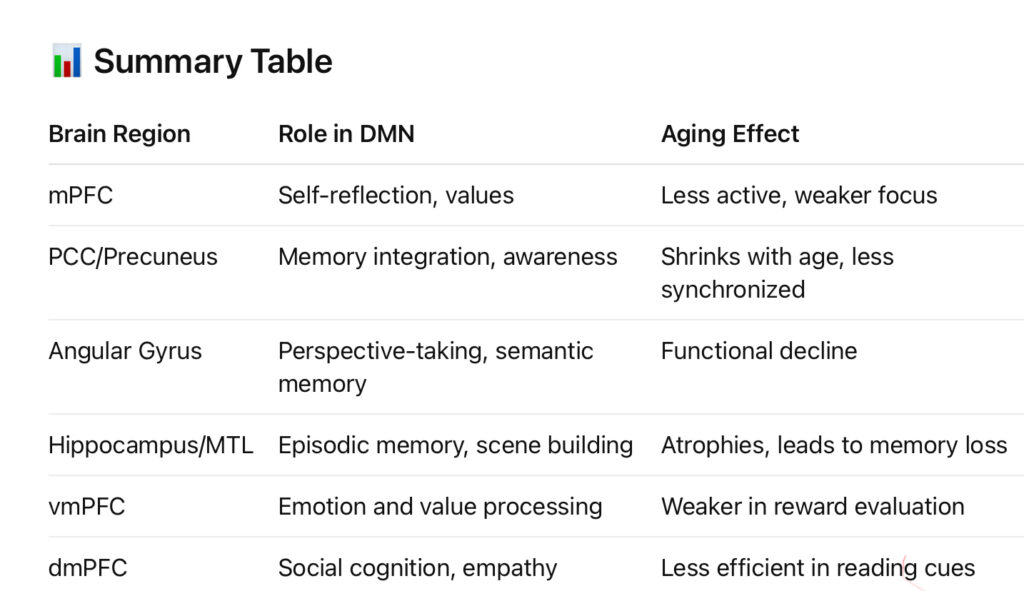
🧠 Core Brain Regions and What They Do:
- Medial Prefrontal Cortex (mPFC):
- Reflects on self-related thoughts and personal decisions.
- Supports emotional evaluation and moral reasoning.
- Posterior Cingulate Cortex (PCC) / Precuneus:
- Central for remembering the past and constructing mental scenes.
- Integrates memories into a coherent “narrative” of the self.
- Angular Gyrus:
- Connects sensory experiences to language and memory.
- Helps you take different perspectives and interpret meaning.
- Hippocampus & Medial Temporal Lobes (MTL):
- Vital for memory, imagining future events, and spatial navigation.
- Links emotions with memories.
- Ventromedial Prefrontal Cortex (vmPFC):
- Assigns emotional value to thoughts and memories.
- Helps process rewards and outcomes of decisions.
- Dorsomedial Prefrontal Cortex (dmPFC):
- Key in understanding social cues and what others might be thinking.
- Supports empathy and social decision-making.
- Retrosplenial Cortex (RSC):
- Handles spatial orientation and connects memory with sensory input.
- Temporal Poles & Lateral Temporal Cortex:
- Provide emotional depth and conceptual knowledge.
- Process stories, social emotions, and relationships.
👵🏽 How Aging Affects the DMN
As we grow older, the brain doesn’t shut down the DMN—but it changes how it works, often reducing its efficiency. Here’s how:
🧓 Aging Effects on DMN:
- Reduced Functional Connectivity:
- The parts of the DMN stop communicating as smoothly.
- This makes it harder to maintain consistent internal thoughts or recall details clearly.
- Brain Shrinkage (Atrophy):
- Regions like the hippocampus and PCC shrink with age.
- This affects both memory strength and emotional stability.
- Harder Time Switching Tasks:
- Normally, the DMN “turns off” when you need to focus.
- In older adults, it stays active longer—causing distractions, slower reactions, or mind-wandering during tasks.
- Memory Lapses & Mental Fatigue:
- As DMN activation patterns become less distinct, it becomes easier to forget things or feel mentally tired.
- Greater Alzheimer’s Risk:
- DMN regions are among the first to show amyloid plaque buildup in Alzheimer’s disease.
- Changes in DMN function can predict cognitive decline even before symptoms appear.
- Increased Mental Noise:
- The DMN may become more intrusive, making it hard to focus or stay organized.
- Compensatory Brain Activity:
- Some older adults activate other brain networks to make up for DMN inefficiency.
- This is a sign of the brain’s plasticity—its ability to adapt.
💡 Final Thoughts
- The Default Mode Network is your internal thought engine—guiding who you are, how you remember, and how you relate to others.
- While aging affects this system, understanding these changes is the first step toward protecting brain health.
- Activities like meditation, learning, social interaction, and physical exercise can help preserve DMN function.