
ChatGPT:
The Infinite Momentum of Yearning — Notes from a Seasoned Museum Wanderer
Museums are where I go to breathe. Not just to see art, but to see how others try to make sense of the world — sometimes through quiet poetry, sometimes through sheer visual noise. So when I found myself standing in the 2025 Taipei Biennial, themed Whispers on the Horizon: The Infinite Momentum of Yearning, I was both curious and skeptical.
Yearning? Momentum? Infinite?
That’s quite a lot of verbs and metaphysics for one afternoon.
But art doesn’t explain itself. It leans. It hovers. It waits for you to meet it somewhere in the middle — and this exhibition, despite its lofty title, did just that. It opened a quiet dialogue across space, time, longing, and what it means to keep moving — not necessarily forward, but inward.
1. Weighted Pause — The Architecture of Slowness
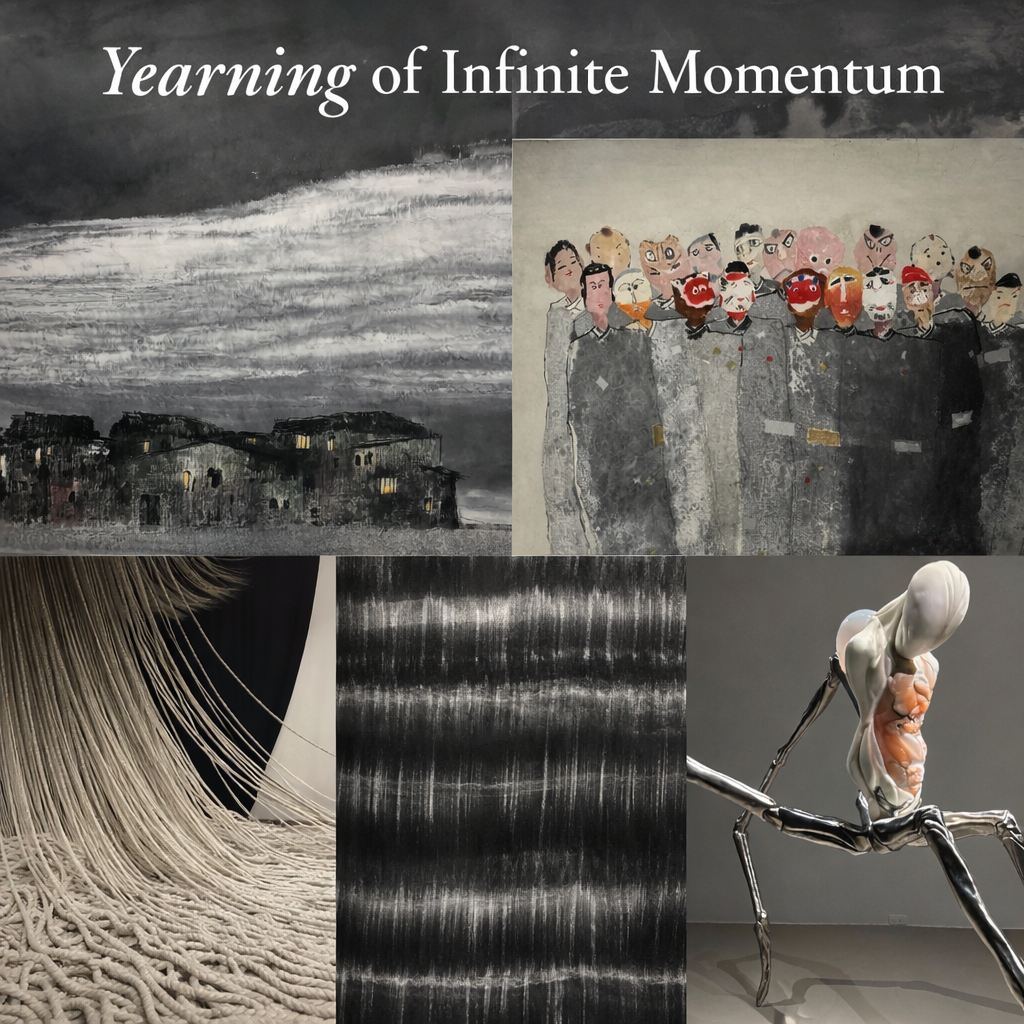
Afra Al Dhaheri’s installation of thick cascading ropes, Weighted Pause, offered a first whisper. The ropes were not decorative; they slumped with intent, grounded by their own weight. The space invited stillness — not absence, but presence. Slowness as ritual. Reflection as structure.
This wasn’t yearning as reaching. It was yearning as settling into — the kind that draws you down into yourself, like gravity made emotional.
The installation didn’t ask for interpretation. It asked for a pause. And in that pause, the idea of “momentum” became paradoxical — something that doesn’t always look like motion, but like still weight pulling toward meaning.
2. Destroy Your Home, Build Up a Boat, Save Life — On Departure and Survival
A carpet, rolled and stacked like half-forgotten scrolls. Hera Büyüktaşçıyan’s work borrowed its title from an ancient Mesopotamian flood story, but the story felt utterly modern: break what you’ve built, leave what you’ve loved, survive.
Here, yearning wasn’t nostalgic. It was brutally practical. If the home cannot hold, then it must become vessel. This kind of transformation doesn’t float gently — it scrapes. The soft textile of the carpet became a survival tool — and with that, an unexpected symbol of resilience disguised as surrender.
It spoke of memory, but in a language that doesn’t comfort — one that rolls itself up and moves on.
3. Clouds in the Dusk — The Quiet Gravity of Ink
Some works whisper louder than others. Ho Huai-Shuo’s Clouds in the Dusk used traditional ink wash to depict fading rooftops under a dense sky, yet it wasn’t nostalgia I felt — it was grief. Not loud, not dramatic — but soaked into the paper like weather that never lifted.
The sky loomed heavy with untold stories. The clouds weren’t metaphor — they were memory blurred by distance. It wasn’t about returning home. It was about standing under the weight of things you’ve lost the words for.
If yearning has a visual language, this was one: subdued, layered, dissolving at the edges, refusing to resolve.
4. I Had Reached the Nothing… — Transformation Without Promise
Ivana Bašić’s unsettling figure — part creature, part human — stood mid-transformation. The sculpture’s title evoked desolation: I had seen the centuries, and the vast dry lands…, yet what I saw wasn’t “nothingness.” It was a body caught in a process too deep for comfort, too slow for drama.
There was no “becoming” in the elegant sense — no butterflies or revelations. Just tension, mutation, soft organs exposed, and metal limbs braced for unknown terrain.
It reflected a different kind of yearning: not for future or past, but for structure in flux. A reaching toward meaning with no map, only instinct.
5. The Masked People — Echoes of Theater and Control
Yuan Chin-Ta’s The Masked People was a curious, crowded watercolor: figures in muted uniforms, each wearing a comically distinct mask. It evoked folk puppetry, political performance, and bureaucratic absurdity — all at once.
Painted a year after martial law was lifted in Taiwan, the work captured the moment between suppression and expression. The masks, instead of hiding, seemed to amplify the falseness of what they covered.
Yearning here was sociopolitical — not for truth, but for the right to shed layers. To step off the stage and be uncast. It was not a question of identity, but of what happens when identity is no longer assigned.
6. Vertical Timeless — Rhythm, Fragility, and the Tension of Repair
Minjung Kim’s work, a large-scale composition made from torn and burnt Hanji paper, offered one of the most meditative interpretations of the exhibition’s theme. The vertical bands of ink and fiber resembled sound waves, or perhaps seismic readings of an emotional landscape.
Kim’s meticulous layering and gentle damage showed yearning as both destruction and recovery — the contradiction of continuity. Her method — staining, tearing, mending — became a form of prayer.
No manifesto. No bold color. Just rhythm and rupture, stitched into something quietly relentless.
Closing Thoughts: Not All Longing Looks the Same
What this exhibition reminded me is that yearning does not always scream, strive, or stretch. Sometimes it sits quietly. Sometimes it folds. Sometimes it transforms without permission.
If momentum exists in these works, it is not about arrival. It is about the movement within holding still. The slow persistence of searching. Of repairing. Of remembering.
The horizon remains unreachable. But maybe that’s the point. We are not meant to arrive — only to continue.
And what a beautiful, baffling thing that is.