
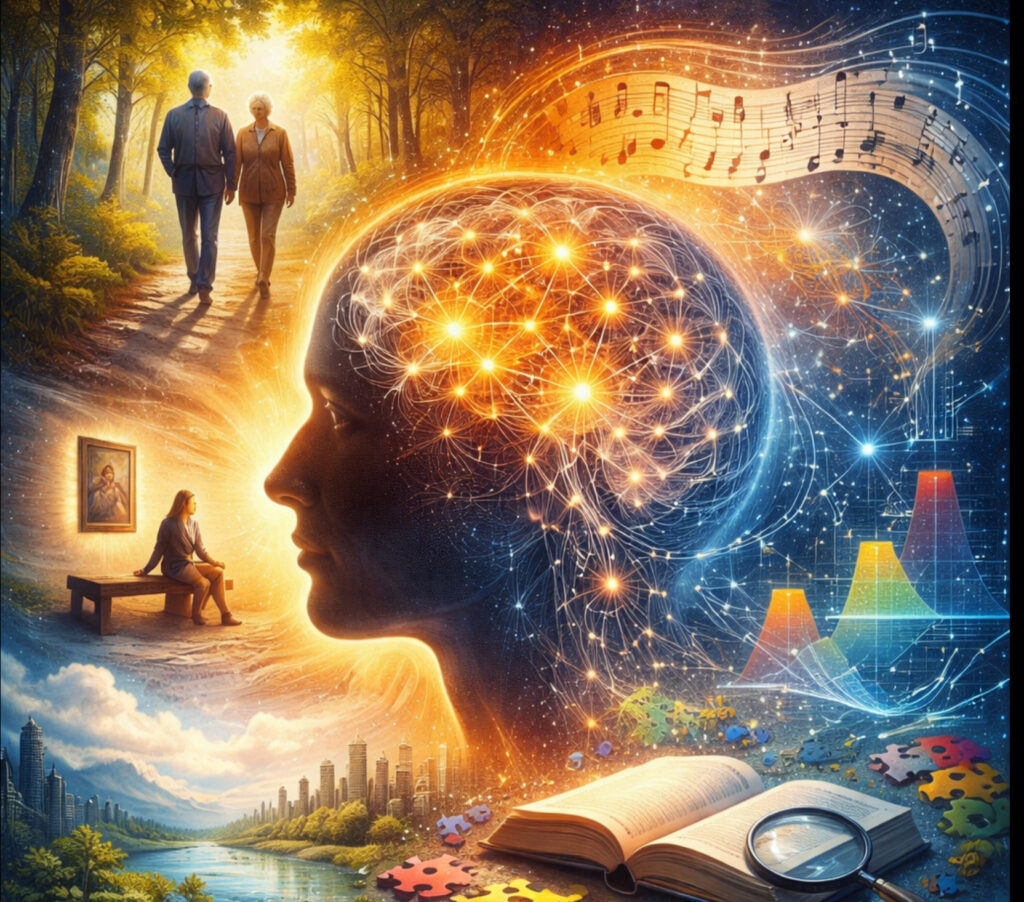
ChatGPT:
🧠 How the Aging Brain Thinks: A Bayesian View of Wisdom, Learning, and Curiosity
1. The basic idea of Bayesian Brain Theory
Bayesian Brain Theory says the brain is not a passive recorder of reality.
Instead, it is a prediction machine:
It uses past experience to form expectations (priors)
It compares those expectations with incoming sensory information (evidence)
It updates its understanding when the mismatch (prediction error) is meaningful
Perception, judgment, and decision-making are all forms of educated guessing under uncertainty.
The brain is constantly balancing:
“What I already believe”
With “What I am sensing right now”
2. What changes with aging: stronger priors, noisier evidence
- As we age, two predictable shifts occur:
- Priors strengthen
- Decades of experience produce stable internal models
- Patterns repeat; lessons accumulate
- Sensory precision may decline
- Vision, hearing, reaction speed, and fine discrimination become noisier
- Priors strengthen
- From a Bayesian perspective, this is not failure — it is rational adaptation:
- When evidence becomes noisy, it makes sense to trust priors more
- The aging brain is not “less intelligent”:
- It is more conservative in updating
3. How this affects decision-making
- Older adults often:
- Decide more slowly
- Change their minds less frequently
- Resist sudden reversals
- Bayesian interpretation:
- The brain requires stronger evidence before revising beliefs
- This reduces:
- Overreaction
- Emotional volatility
- Susceptibility to noise
- But it can increase:
- Resistance to novelty
- Vulnerability to outdated assumptions in fast-changing environments
4. Why some older adults become
better
decision-makers
- Aging improves decisions when:
- Priors are well-calibrated
- The environment is familiar or semi-stable
- Older adults often excel at:
- Risk management
- Long-term judgment
- Emotional regulation
- Detecting what doesn’t matter
- Bayesian translation:
- Strong priors reduce false alarms
- Emotional prediction errors are dampened
- What looks like “slowness” is often precision control, not decline
5. Cognitive reserve: a Bayesian definition
- Cognitive reserve is often described vaguely as “extra capacity.”
- Bayesian Brain Theory gives it a sharper meaning:
- Cognitive reserve is the ability to keep strong priors flexible and evidence meaningful.
- High reserve brains:
- Maintain multiple internal models (ensembles)
- Can reroute around damage or noise
- Update gradually instead of freezing
- Low reserve brains:
- Collapse toward a single explanation
- Over-rely on habit
- Lose adaptability
6. Why lifelong learning matters (and what kind matters)
- Lifelong learning does not mainly protect memory.
- It protects the updating mechanism itself.
- Effective lifelong learning:
- Preserves sensory precision
- Keeps priors from narrowing too much
- Trains tolerance for ambiguity
- Passive consumption (summaries, rote facts):
- Confirms priors
- Reduces uncertainty too quickly
- Weakens reserve over time
- Active engagement:
- Strengthens Bayesian balance
- Maintains adaptability
7. Why music uniquely supports Bayesian updating
- Music is prediction without words:
- Rhythm sets expectations
- Melody violates and resolves them
- You cannot skim music.
- The brain must:
- Continuously predict
- Adjust timing expectations
- Regulate emotion
- Bayesian benefits:
- Trains dynamic prediction error handling
- Improves emotional calibration
- Preserves uncertainty tolerance
- Music is Bayesian exercise without intellectual strain.
8. Why walking is powerful for aging cognition
- Walking supplies:
- Reliable sensory input (movement, balance, visual flow)
- Low cognitive demand
- No forced conclusions
- Bayesian effects:
- Sensory precision quietly improves
- Prediction errors remain gentle and continuous
- Priors reorganize without being attacked
- Walking alone adds:
- No social pressure
- No performance demand
- No need for closure
- This creates ideal conditions for slow belief updating.
9. Why art and museums work differently from explanations
- Art provides:
- Rich sensory evidence
- Without a single correct interpretation
- Museums create:
- Silence
- Slow movement
- Permission to linger
- Bayesian impact:
- Ensembles of meaning remain open
- Priors soften and rearrange
- Updating happens below language
- This is why art can move people emotionally:
- Tears signal recalibration, not nostalgia
10. Why curiosity beats memory drills
- Memory drills train:
- Retrieval
- Speed
- Short-term performance
- But they do little for:
- Model flexibility
- Evidence weighting
- Uncertainty handling
- Curiosity does the opposite:
- Keeps questions alive
- Invites prediction errors
- Encourages exploration without pressure
- Bayesian translation:
- Curiosity keeps the posterior broad
- Memory drills narrow it
11. The deep principle tying it all together
- Aging cognition thrives not on:
- Speed
- Volume
- Information accumulation
- But on:
- Calibration
- Flexibility
- Meaningful updating
- Music, walking, art, and curiosity all:
- Preserve uncertainty
- Protect sensory engagement
- Prevent premature closure
🧭 Final takeaway
Bayesian Brain Theory shows that aging minds do not fail — they rebalance.
Cognitive reserve depends on maintaining that balance.
Lifelong learning is not about remembering more.
It is about keeping the brain capable of revising what it already knows.
And the best tools for that are not drills or summaries —
but curiosity,
movement,
music,
and art.